
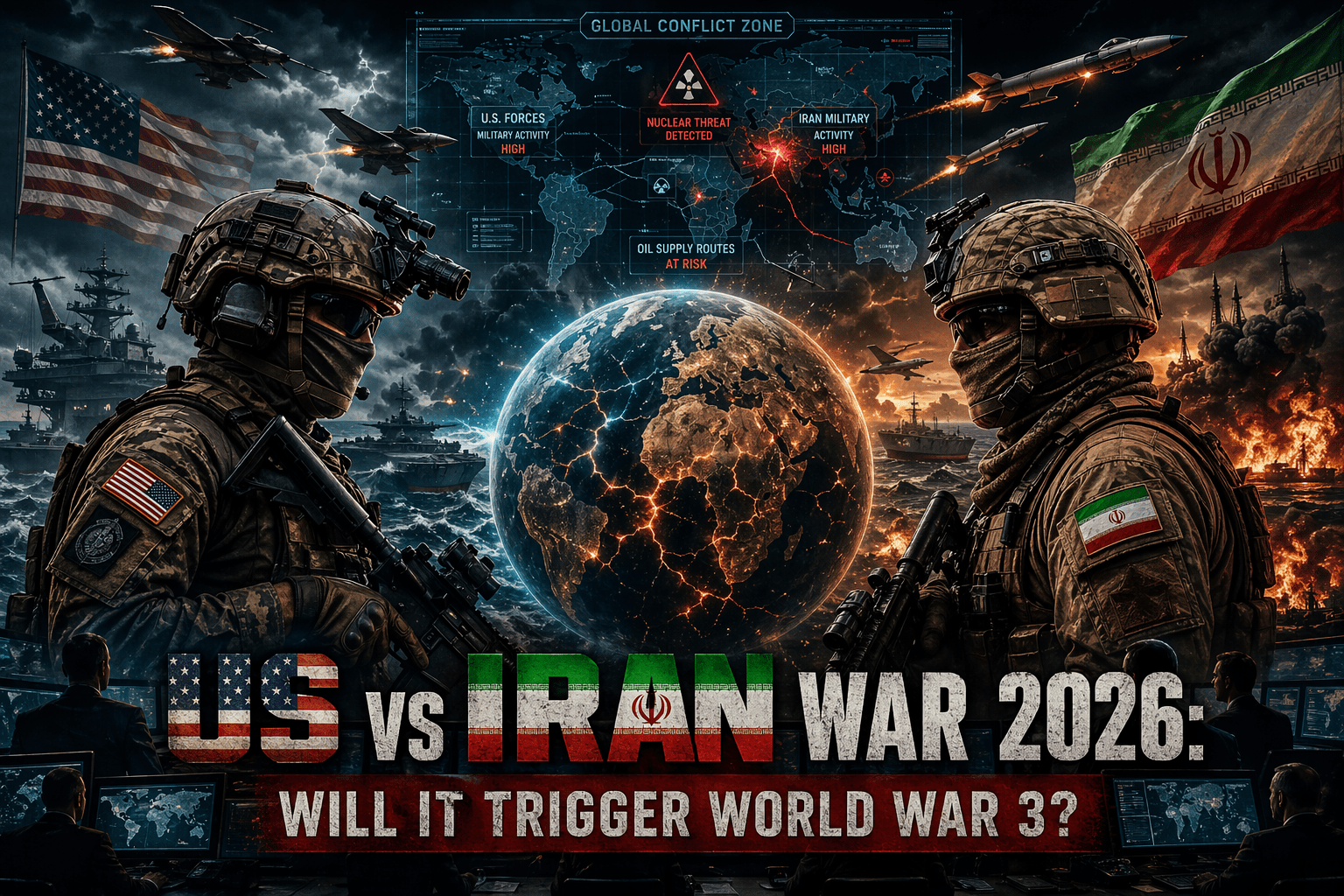
The United States and Israel have launched military strikes on Iran’s nuclear and military sites. Iran retaliated with missiles, drone swarms, and closed the Strait of Hormuz. Ceasefire talks are hanging by a thread. Here is the full 2026 Iran War explained — what happened, why it matters, and what could come next.
Barrels blocked/day
Worst-case oil/barrel
Ceasefire expired
US · Israel · Iran

The world woke up to a completely different Middle East in 2026. What many analysts had been warning about for years finally happened: the US and Iran war crossed from a cold confrontation into a hot military conflict. This is not a drill. This is not a proxy skirmish. The Iran war 2026 involves direct US and Israeli military strikes on Iranian soil, Iranian ballistic missiles fired at American bases, and a naval blockade that is already reshaping global oil prices.
If you are trying to understand what is really happening, why it started, what Iran did in response, and whether this could spiral into World War 3 — you are in the right place. This is the most comprehensive, up-to-date breakdown you will find anywhere.
The 2026 Iran War: How Did We Get Here? A Full Timeline
The Iran war 2026 did not start overnight. It is the product of decades of tension, broken nuclear deals, proxy conflicts, and an arms race that the international community failed to stop. But the immediate trigger came in early 2026 when US and Israeli intelligence concluded that Iran was just weeks from a functional nuclear weapon.
2026
2026
2026
2026
2026
2026
What Did the US and Israel Strike? Iran’s Nuclear and Military Sites Explained
The US and Israel did not just fire a few missiles and call it a warning. The strikes on Iran’s nuclear sites were one of the most precise and large-scale military operations the Middle East has seen since the 2003 Iraq War.

US and Israeli air forces conducted coordinated precision strikes on Iran’s nuclear infrastructure in early 2026 | Source: Pexels (Illustrative)
Primary Targets Hit in the Iran Nuclear Strike
The primary targets included the Natanz uranium enrichment facility, which housed Iran’s most advanced centrifuge arrays; the underground Fordow facility buried deep inside a mountain and long considered nearly impenetrable; and the Isfahan nuclear technology center responsible for fuel conversion. Alongside nuclear sites, US strikes also hit IRGC air defense batteries, radar systems, and command-and-control infrastructure to suppress Iran’s ability to respond effectively in the air.
The Fordow facility was buried under 90 meters of rock. Only the US Air Force’s Massive Ordnance Penetrator (MOP) — the world’s most powerful bunker-buster bomb — was capable of reaching it. The use of this weapon signaled this was a maximum-effort operation, not a symbolic strike.
Israeli F-35 stealth fighters, operating from undisclosed regional bases, carried out simultaneous precision strikes on Iranian ballistic missile launch pads and drone storage depots. This was designed to degrade Iran’s retaliatory capability before it could be used — but as history shows, it did not fully succeed.
How Iran Responded: Missiles, Drones, and the Strait of Hormuz
Iran’s response to the US and Israel strikes was swift, multi-layered, and far more powerful than many Western analysts had anticipated. The Supreme Leader authorized a three-pronged retaliation strategy that combined direct military action, proxy warfare, and an economic chokehold on the global oil supply.
Iran’s Missile and Drone Campaign
Within 72 hours of the initial strikes, Iran’s IRGC Aerospace Force launched a barrage of Shahab-3, Emad, and Fattah-2 hypersonic missiles at US military installations in Iraq and Qatar. Simultaneously, waves of Shahed-series kamikaze drones were deployed against US naval assets in the Persian Gulf. While US and allied air defense systems intercepted a significant portion of the incoming fire, multiple US bases suffered structural damage and casualties were reported.
Proxy Networks Activated Across the Middle East
Iran immediately activated its broader “Axis of Resistance” network. Hezbollah in Lebanon launched thousands of rockets into northern Israel, forcing massive civilian evacuations. Houthi forces in Yemen, already familiar from years of Red Sea operations, dramatically escalated attacks on commercial shipping and US warships in the Red Sea and Gulf of Aden. Iranian-backed militia groups in Iraq and Syria began targeting US forces and diplomatic installations across the region.
The Strait of Hormuz Closure — Iran’s Ultimate Economic Weapon
The most consequential move Iran made was closing the Strait of Hormuz on April 18, 2026. This narrow waterway — just 33 kilometers at its tightest point — carries approximately 20 million barrels of oil per day, representing about 20% of the world’s total seaborne oil supply. By deploying IRGC naval forces and mining key shipping lanes, Iran turned the most important waterway on the planet into a war zone.
“Closing the Strait is not just a military move — it is a declaration that Iran is willing to burn the global economy down to survive.”
— Anonymous senior US defense official, cited in regional media reports
The Global Oil Price Shock: What the Iran War 2026 Is Doing to Your Economy
Global oil shipping has been severely disrupted since Iran closed the Strait of Hormuz on April 18, 2026 | Source: Pexels (Illustrative)
The economic consequences of the Iran war 2026 are already being felt everywhere from fuel stations in Manchester to grocery stores in Karachi. With the Strait of Hormuz closed and no clear reopening timeline, global energy markets are in crisis mode.
Before the crisis, approximately 20 million barrels of oil passed through the Strait of Hormuz every day. That represents Saudi Arabia’s entire export capacity, plus the combined exports of the UAE, Kuwait, Iraq, and Qatar. Analysts at Goldman Sachs and JP Morgan have modeled worst-case oil prices ranging from $150 to $200 per barrel if the blockade continues beyond 30 days.
Countries most immediately affected include Japan, South Korea, India, and China — all of which depend heavily on Gulf oil. European nations are also facing natural gas supply disruptions through Qatar’s LNG exports, which also transit via the Gulf. In the United States, domestic shale production has cushioned the immediate blow, but global price inflation is still hitting American consumers at the pump and in the supermarket.
For investors watching energy markets, the oil price shock has created both extreme risk and potential opportunity. Our finance team has covered the investment angle in detail — including which oil stocks are best positioned to benefit from this crisis.
The Islamabad Ceasefire Talks: What Happened and Why They Are Failing
The most significant diplomatic development in the US Iran conflict 2026 came when both sides agreed to direct face-to-face talks hosted by Pakistan in Islamabad on April 11–12, 2026. It was the first direct US–Iran negotiation in years, and the world held its breath.
The talks lasted over 21 hours — an extraordinary length that reflected both the complexity of the issues and the genuine desire of both parties to avoid further escalation. However, they collapsed on the central issue of uranium enrichment. The United States and Israel demanded a complete halt to Iranian uranium enrichment for at least 20 years, with unlimited IAEA inspections. Iran offered a 3-to-5-year moratorium — a gap so wide it proved impossible to bridge overnight.
A temporary ceasefire was brokered to allow talks to continue, but that ceasefire expired on April 21, 2026. As of today, April 22, 2026, the ceasefire has not been formally renewed, though both sides have indicated they are still communicating through back channels. The situation remains on a knife’s edge.
The ceasefire has expired. No formal renewal has been announced. Back-channel communications reportedly continue, but there is no confirmed date for the next round of talks. IRGC naval forces remain deployed in the Strait of Hormuz. US carrier groups are positioned in the Arabian Sea.
For more detailed coverage of the ceasefire negotiations and their collapse, including direct reporting from regional sources, you can read our dedicated analysis on the Iran–US nuclear talks.
Could the Iran War 2026 Trigger World War 3? An Honest Assessment
This is the question everyone is asking. Could the US vs Iran war become the spark that ignites World War 3? The answer requires an honest look at who the major players are, what their interests are, and how escalation dynamics actually work in modern geopolitics.
Who Are the Key Global Players Watching This Conflict?
Russia has expressed political and diplomatic support for Iran, calling the US-led strikes “destabilizing” and a violation of international law. However, Russia is deeply preoccupied with its own military entanglements and has not committed any military assets to Iran’s defense. The Russia–Ukraine war has depleted Russian military readiness significantly.
China has called for immediate de-escalation and positioned itself as a neutral diplomatic broker. Chinese economic interests — particularly its massive oil imports from the Gulf — actually align more with a peaceful resolution than with a prolonged conflict. China has not made any military commitments to Iran.
NATO allies have publicly supported the US position but have been careful not to commit military forces. The UK, France, and Germany have activated contingency plans to protect their energy supply chains and have deployed naval assets to the Arabian Sea for convoy escort duties.
| Scenario | Probability | What Would Trigger It | Global Impact |
|---|---|---|---|
| Ceasefire + Deal | 35% | Iran accepts partial enrichment limits; US lifts some sanctions | Oil prices stabilize; regional tensions ease gradually |
| Prolonged Stalemate | 40% | Neither side escalates but neither backs down; proxy war continues | Sustained high oil prices; humanitarian crisis in Lebanon/Yemen |
| Major Escalation | 20% | Iran strikes European energy infrastructure or kills senior US commander | NATO involvement; risk of direct superpower confrontation rises sharply |
| World War 3 | <5% | China or Russia commits military forces; nuclear threat activated | Catastrophic global consequences; worst-case economic and humanitarian crisis |
Most credible analysts place the probability of a genuine World War 3 scenario — involving direct conflict between nuclear powers — at below 5%. The more likely outcomes are either a negotiated settlement or a prolonged, painful stalemate that keeps the Middle East in a state of low-to-medium intensity conflict for months or years to come.
That said, the risk is not zero, and history has shown that wars have a way of escalating beyond what anyone intended. The assassination of Archduke Franz Ferdinand was supposed to be a regional incident. The shooting at Sarajevo was not supposed to become the First World War.
For broader historical context on how regional conflicts escalate into global wars, the Council on Foreign Relations Global Conflict Tracker provides an excellent, continuously updated resource. Similarly, the BBC Middle East coverage offers reliable, on-the-ground reporting from regional correspondents.
What Happens Next? 3 Possible Outcomes for the Iran War 2026

The outcome of the Iran–US conflict in 2026 will reshape global geopolitics for decades to come | Source: Pexels (Illustrative)
Outcome 1: A Negotiated Settlement (Most Hopeful)
Both sides ultimately agree on a phased nuclear deal — Iran accepts stricter enrichment limits in exchange for meaningful sanctions relief and a US pledge of non-aggression. The Strait of Hormuz reopens. Oil prices fall back toward $80–100 per barrel. This is the scenario the global economy is praying for, but it requires both the US and Iranian governments to accept political compromises that are domestically painful for each.
Outcome 2: Prolonged Proxy Stalemate (Most Likely)
Neither side achieves a decisive victory or breakthrough in talks. The conflict settles into a grinding proxy war — Hezbollah continues to fight Israel on the northern front, Houthi attacks persist in the Red Sea, and Iranian and US forces engage in episodic skirmishes without a full-scale confrontation. Oil prices stabilize at elevated levels. This “frozen conflict” state could persist for 12 to 24 months before a breakthrough or collapse.
Outcome 3: Full Escalation and Catastrophe (Worst Case)
If Iran decides it has nothing to lose — if the IRGC leadership concludes that compromise means regime collapse — they could escalate dramatically: mining the Strait of Hormuz completely, firing missiles at Israeli population centers, or activating sleeper cells in Western countries. Any of these moves would trigger a military response so severe that the broader Middle East would be engulfed in war. This is the scenario that every world leader is working urgently to prevent.
How the Iran War 2026 Is Affecting the Entire World Right Now
The ripple effects of the Iran war 2026 are not limited to the Middle East. From energy markets to food prices, from refugee flows to global internet infrastructure, this conflict is touching virtually every corner of the planet.
In Pakistan, the country that hosted the ceasefire talks, there is intense domestic pressure as fuel prices spike and millions of citizens who rely on affordable energy face serious economic hardship. Pakistan’s diplomatic role as a neutral broker has given it rare international visibility, but also exposed it to pressure from all sides.
In Europe, governments are scrambling to diversify their LNG supply away from Qatar while simultaneously managing the political fallout from supporting US military action. Several European cities have seen large anti-war protests.
In South and Southeast Asia, countries like India, Japan, South Korea, and Taiwan — all heavily dependent on Gulf energy — are facing both economic pressure and strategic anxiety about what a prolonged conflict means for their own security environments.
For the most authoritative real-time updates on the Iran–US military situation, we recommend following Reuters Middle East coverage and the Al Jazeera Middle East desk, both of which maintain correspondents on the ground across the region. For economic impact analysis, Bloomberg Energy provides the most detailed oil market reporting.
Final Thoughts: The 2026 Iran War Is a Turning Point for the World
Let’s be honest about what this moment really is. The Iran war 2026 is not just another Middle East conflict. It is a fundamental test of the international order that has governed the world since 1945 — a system based on nuclear non-proliferation, the rule of law, and the principle that no nation can simply acquire weapons of mass destruction without consequence.
The United States and Israel made the calculation that the danger of a nuclear Iran outweighed the danger of military action. Iran made the calculation that the danger of capitulating to Western pressure outweighed the danger of war. Both sides made bets. Now the entire world is living with the consequences of those bets.
Whether this ends with a deal, a stalemate, or something much worse depends on decisions being made right now in Washington, Tehran, and every capital in between. One thing is certain: the world that existed before March 2026 is not coming back. This is a new era, and the choices made in the coming weeks will define global geopolitics for a generation.
This is a developing, rapidly changing situation. Bookmark DailyUpdates360 World News for the latest updates on the Iran War 2026, ceasefire talks, Strait of Hormuz status, and global economic impact. We update our coverage daily with the most current information available.