
● Live Updates📅 April 27, 2026✍️ DailyUpdates360 Editorial Team🕐 12 Min Read
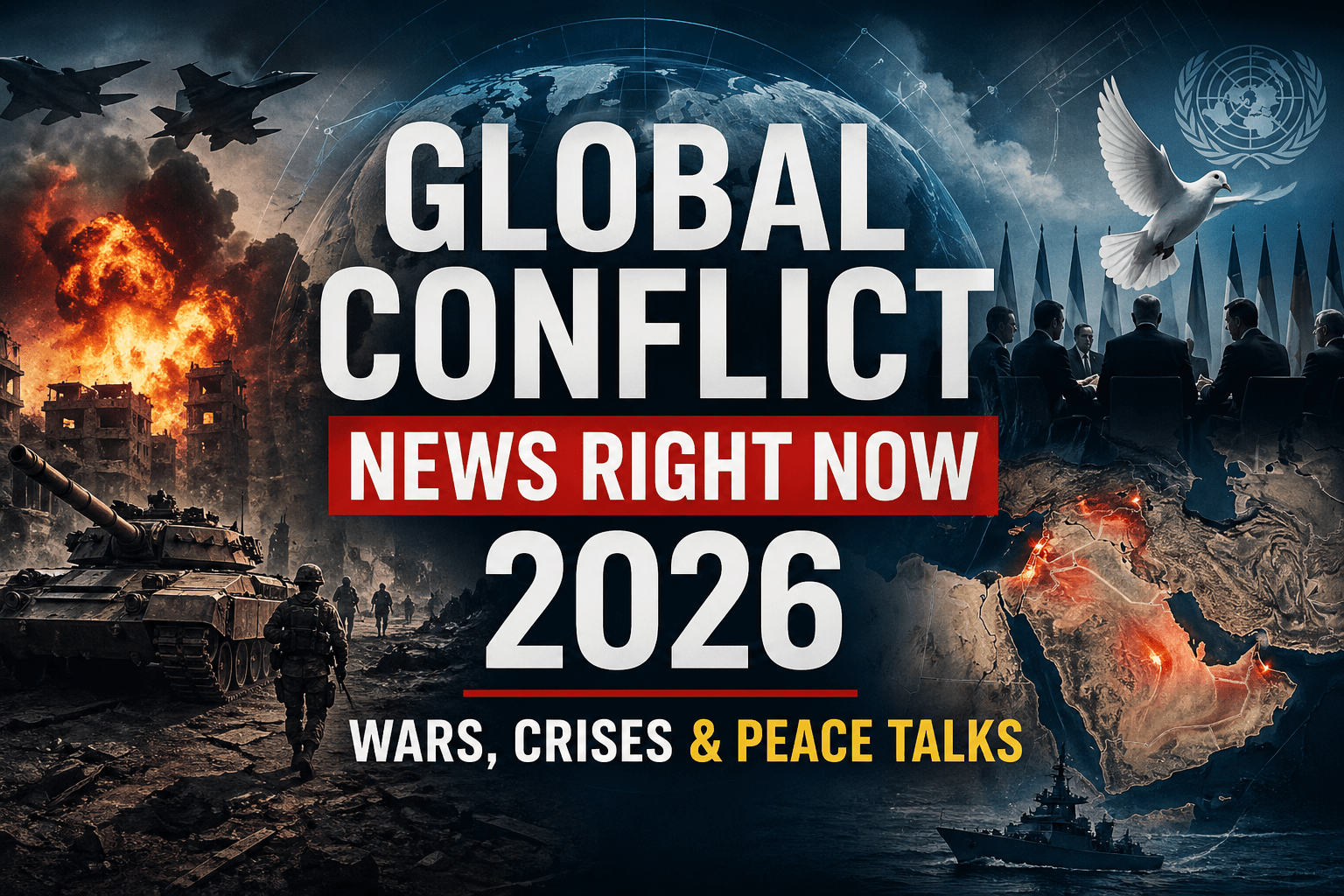
The world in April 2026 is more fractured than at any point in recent memory. From the explosive US–Israel strikes on Iran that reshaped the Middle East, to a grinding war in Ukraine now entering its fifth year, to the forgotten horror of Sudan’s civil war — global conflict news right now is impossible to summarise in a single headline. This comprehensive guide breaks down every major active conflict, the latest peace negotiations, and what it all means for the world’s 8 billion people.
🇮🇷🇺🇸
US–Iran War
Conditional Ceasefire
Launched Feb 28 2026. Ceasefire declared April 8. Pakistan-mediated talks ongoing.
🇷🇺🇺🇦
Russia–Ukraine War
Active Conflict
Year 5. Drone escalation. Russia holds ~20% of Ukraine. Peace talks stalled.
🇮🇱🇵🇸
Gaza Conflict
Diplomacy Ongoing
Extended ceasefire. Israel retains partial territorial control. Humanitarian crisis worsens.
🇸🇩
Sudan Civil War
Active Conflict
Largest displacement crisis on earth. Famine spreading. International response inadequate.
🇮🇱🇱🇧
Lebanon–Israel
Fragile Truce
2026 Lebanon War caused 2,000+ civilian deaths. Hezbollah degraded but rearming.
🌐
Global Military Spend
Record Levels
$2.9 trillion in 2025 — 11th consecutive year of growth. GDP share highest since 2009.
1. The US–Iran War 2026: How the Middle East’s Biggest Conflict Began and Where It Stands
On February 28, 2026, the world woke up to a new chapter in Middle East history. The United States and Israel launched coordinated airstrikes against Iran, targeting military installations, government sites, and nuclear infrastructure. According to a UK House of Commons Library briefing, the strikes killed Supreme Leader Ali Khamenei and were intended to weaken Iran’s nuclear and ballistic missile programmes while also increasing pressure for regime change.
The context is critical. Iran entered 2026 already weakened. Massive domestic protests, driven by a weakened economy and failing infrastructure, were violently suppressed by Iranian security forces. Many of Iran’s regional proxy allies, including Hezbollah, had already been severely weakened by earlier Israeli military operations. Indirect nuclear negotiations in February also collapsed after US President Trump stated that he was “not thrilled” with the proposed terms. later, the bombs fell.
Related on DailyUpdates360: US–Israel–Iran War 2026: Causes, and Global Impact
Iran’s retaliation was swift and broad. Hundreds of drones and ballistic missiles were launched against Israel, US military bases in Bahrain, Jordan, Kuwait, Qatar, Saudi Arabia, and the UAE. The Strait of Hormuz — the vital waterway through which roughly 20% of the world’s oil passes — was closed. A drone struck Britain’s Akrotiri military base on Cyprus. Missiles were intercepted over Turkey. Civilian infrastructure in Oman and Azerbaijan was hit.
The Arab-Israeli conflict has expanded into a full-scale regional war.— Maged Abdelfattah Abdelaziz, Arab League Permanent Observer to the UN, Feb 28, 2026
A conditional ceasefire was announced on April 8, 2026, with Pakistan serving as the mediating party. As of today, April 27, talks are ongoing. Iran’s Foreign Minister has been conducting diplomatic rounds — most recently heading to Moscow to meet with President Putin — as Tehran assesses whether Washington is, in the words of Iranian officials, “truly serious about diplomacy.” The Strait of Hormuz, critical to global energy markets, remains a point of contention in the negotiations. For global conflict news right now, this is the single most consequential flashpoint.
Feb 28
Date War Began
Apr 8
Ceasefire Declared
1,000s
Drones/Missiles Fired
6+
Countries Struck
2. Russia–Ukraine War April 2026: Drone Escalation and Stalled Peace Talks
The Russia–Ukraine war is now in its fifth year, and it shows little sign of ending. As of late April 2026, Russian forces control roughly 20% of Ukrainian territory — an area comparable in size to the US state of Pennsylvania. But the momentum has recently shifted. Between March 24 and April 21, 2026, Russian forces suffered a net loss of 2 square miles of Ukrainian territory, according to analysis from Russia Matters at Harvard’s Belfer Center.
The drone war has become the defining feature of this conflict’s current phase. In March 2026, Russia launched more drones against Ukraine than in any previous month of the war — yet Ukraine intercepted an remarkable 92% of them. Ukraine, for its part, has been targeting Russian oil infrastructure with increasing precision. Strikes on refineries in Yaroslavl and attacks on key ports like Ust-Luga and Primorsk have forced Russia to cut oil production by an estimated 300,000–400,000 barrels per day — the sharpest monthly reduction in roughly six years.
The humanitarian toll on Ukraine is severe. The country has lost approximately 70% of its electricity generation capacity since the full-scale invasion began. Kyiv residents face up to 16 hours without power daily, driving hundreds of thousands to leave the capital. Cities like Dnipro, Kharkiv, and Kramatorsk are regularly struck, with civilian deaths recorded in April 2026. Ukraine’s total combat loss estimates for Russian forces have surpassed 1.3 million personnel since February 2022.
Also Read on DailyUpdates360:Ukraine War Latest News: What’s Happening on the Front Lines →
On the diplomatic front, peace remains elusive. Russia rejected Ukrainian President Zelensky’s proposal for an Orthodox Easter ceasefire. The Kremlin has reportedly told Washington it would harden its peace terms if Ukrainian forces did not withdraw from the Donetsk region. Western allies, meanwhile, continue providing military and humanitarian support, though the scale has fluctuated amid shifting US priorities under the Trump administration.
Key Ukraine War Timeline — Recent Weeks
April 26, 2026
Crimea struck by massive Ukrainian drone attack. Explosions reported near Kacha and Belbek airfields. Ukraine destroys Russian shelter in Kupiansk sector.
April 25–26, 2026
Ukraine attacks Russian oil refinery in Yaroslavl. Russia shelled 18 settlements in Kharkiv region. Nine dead in Dnipro strikes.
March 2026
Russia declared “liberation” of Luhansk oblast. Spring offensive saw territorial gains. Ukraine intensified drone campaign against Russian oil ports.
March 24 – April 21, 2026
Russian forces endured net loss of 2 square miles. Ukraine’s interception rate of Russian drones reached 92%.
3. Gaza Conflict 2026: Ceasefire Extended but Crisis Far From Over
More than two and a half years after Hamas’s October 7, 2023 attack triggered the Gaza war, the situation remains one of the most watched conflicts in global conflict news right now. A ceasefire was negotiated in early 2026, and its extension has been welcomed by civilians in Beirut and across the region — but the underlying issues are unresolved.
Israel’s military campaigns against Iran and Hezbollah in 2025–2026 have significantly weakened those adversaries. Hamas, while degraded, remains standing. After 925 days of fighting, Israel has not achieved a decisive military victory. Israel now controls significant portions of Gaza and has continued settlement expansion in the West Bank, with ministers hinting at formal annexation of territory — a prospect condemned by the US, UAE, and nearly every other government.
The Trump administration’s “day-after” plan for Gaza — involving resettlement in Arab countries — has been rejected by Arab governments and Palestinian groups alike. If the plan fails, millions of Palestinians will remain in a fragmented territory under heavy Israeli restriction. If it succeeds through diplomatic coercion, Palestinians will have been excluded from decisions about their own future. The International Crisis Group’s 10 Conflicts to Watch in 2026 describes this as one of the defining fault lines of the current era.
Related on DailyUpdates360: Iran–Israel War 2026
Lebanon separately experienced an Israeli offensive in 2026, resulting in over 2,000 civilian and militant deaths. Israel launched military operations against Hezbollah following its attacks in support of Iran. The Lebanese government — which had itself tried to disarm Hezbollah — banned the group’s military activities, but Hezbollah retains significant weaponry and community support. A fragile truce has held, but Lebanese civilians interviewed by NBC News described relief at its extension while expressing doubt that lasting peace is near.
4. Sudan’s Forgotten Civil War: The World’s Worst Humanitarian Crisis You May Not Be Following

While global attention focuses on the Middle East and Ukraine, Sudan’s civil war — now in its third year — represents arguably the world’s most severe active humanitarian catastrophe. More than 11 million Sudanese people have been displaced, and the UN has described the famine spreading through Darfur and Kordofan as among the worst in the world.
The conflict pits the Sudanese Armed Forces (SAF) against the paramilitary Rapid Support Forces (RSF). Drone strikes on civilians have been documented in villages throughout North Darfur, West Darfur, and South Kordofan as recently as January 2026, killing people in markets and medical clinics. The RSF has been accused of ethnic cleansing and genocide, particularly in El-Geniena in West Darfur state.
The conflict is deeply internationalised. According to the Wilson Center’s regional conflict map, more than ten countries are actively involved, including Egypt, Saudi Arabia, the UAE, Turkey, Russia, and China — backing different sides according to their strategic interests. Saudi Arabia and the UAE, both traditionally allied, are on opposite sides: Riyadh backs the SAF while Abu Dhabi supports the RSF. This proxy dynamic is a major reason all peace negotiations have failed. The UN estimates over 1.1 million people face the immediate risk of losing food, water and healthcare without emergency funding.
5. The Bigger Picture: Global Military Spending, North Korea and Conflict Trends in 2026
Zooming out, the scale of global conflict news right now reflects a structural shift in world order. Global military spending reached nearly $2.9 trillion in 2025, marking an eleventh consecutive year of growth, according to a major research report. The share of global GDP devoted to military spending reached its highest level since 2009 — a direct result of the cascade of conflicts described in this article.
North Korea has risen to a Tier I threat level in the Council on Foreign Relations’ 2026 Preventive Priorities Survey. Pyongyang sent troops to fight alongside Russian forces in Ukraine — a development acknowledged in an official ceremony in North Korea where Russian Defence Minister Belousov met Kim Jong Un. A memorial museum was opened honouring North Korean soldiers killed fighting for Russia. This military relationship deepens the geopolitical alignment between Moscow and Pyongyang, with implications for broader Asia-Pacific security.
Colombia saw a highway bombing in late April that killed 20 people and wounded 36 — the deadliest attack in years, attributed to armed groups, arriving just weeks before presidential elections. India and Pakistan’s exchange of fire in 2025 was described as the worst in decades. Afghanistan and Pakistan have also clashed along their border. Africa’s conflict landscape worsened in the Sahel, where nine separate conflict contingencies are rated as active priorities.
Frequently Asked Questions
What is the current status of the US–Iran war in 2026?
The US and Israel launched joint airstrikes on Iran on February 28, 2026, killing Supreme Leader Ali Khamenei and targeting Iran’s nuclear and military infrastructure. Iran retaliated with drone and missile attacks across the region and closed the Strait of Hormuz. A conditional ceasefire was declared on April 8, 2026, with Pakistan mediating ongoing peace negotiations. Iran’s foreign minister is currently engaged in diplomacy with Russia and other regional powers as talks continue.
Which countries are currently at highest risk from armed conflict in 2026?
According to the Council on Foreign Relations’ 2026 Preventive Priorities Survey, the highest-risk active conflict zones include Iran (regional war), Gaza, Ukraine, Lebanon, North Korea, and Sudan. Secondary concerns include Somalia, Haiti, Mexico (due to US military operations against cartels), the South China Sea, and numerous African nations in the Sahel and Great Lakes regions.
How does the Iran war affect global oil prices and energy supply?
Iran’s closure of the Strait of Hormuz — through which approximately 20% of the world’s oil flows — caused immediate disruption to global energy markets. Attacks on Gulf infrastructure, including UAE oil and gas facilities, compounded the shock. Even with the conditional ceasefire in April 2026, energy markets remain volatile. Analysts warn that any breakdown in peace talks could reignite supply disruptions, pushing oil prices sharply higher.
© 2026 DailyUpdates360.com · All Rights Reserved · Privacy Policy · Contact Us
Sources: UK Parliament Research Briefings · Council on Foreign Relations · International Crisis Group · Russia Matters / Harvard Belfer Center · Wilson Center · Al Jazeera · UN News · Yahoo News / Reuters