
DailyUpdates360 World NewsTech & AIFinanceContact
🌍 World News — Breaking
📅 April 21, 2026✍️ DailyUpdates360 Team⏱ 12 min read🌐 NewWorldUpdates.com
~20MBarrels blocked per day
20%Of global seaborne oil
$200Analyst worst-case per barrel
23Ships turned back by US Navy
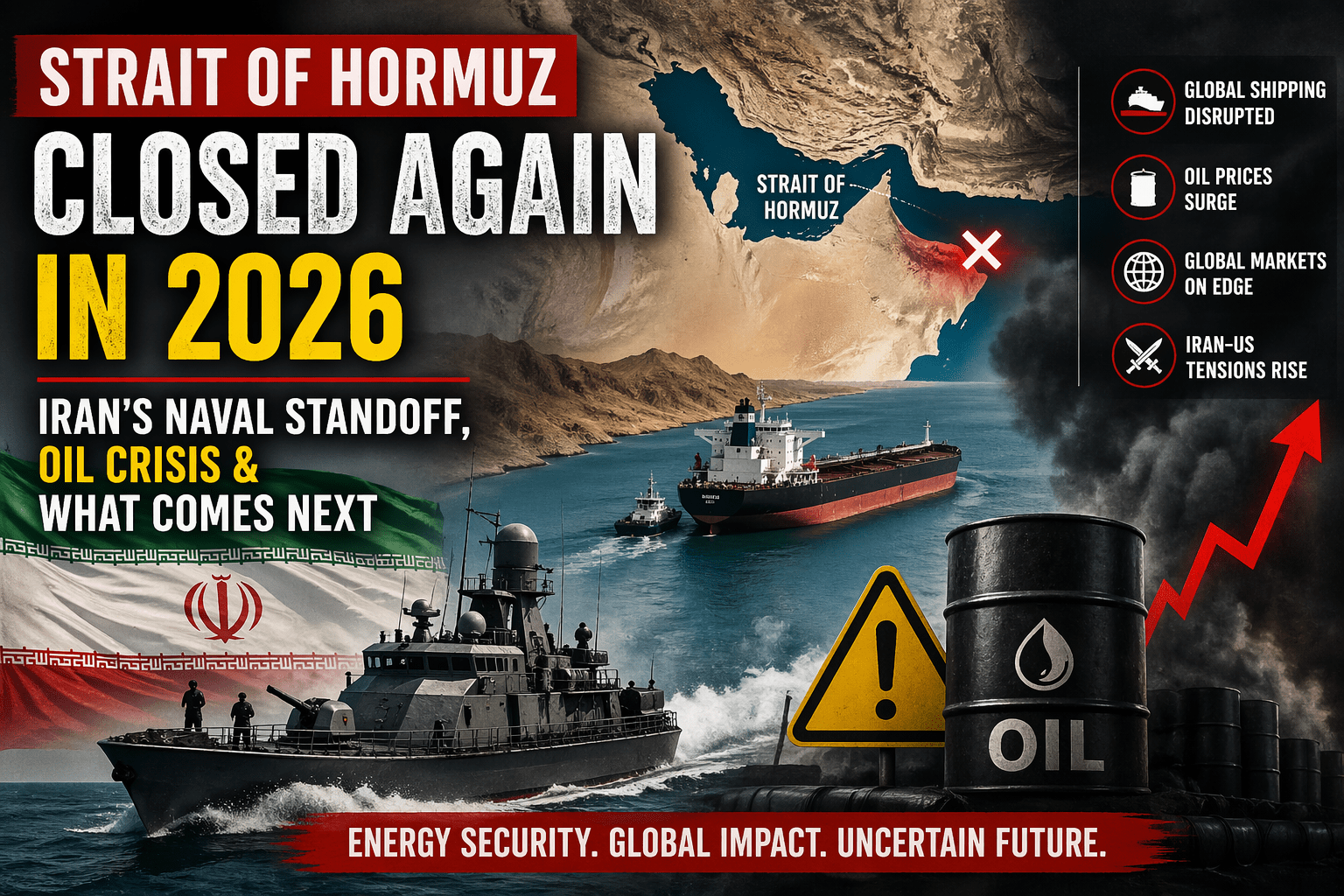
Welcome to NewWorldUpdates.com — your go-to source for everything happening in the world right now. On April 18, 2026, Iran’s Islamic Revolutionary Guard Corps (IRGC) announced the Strait of Hormuz is closed again — for the second time in six weeks — sending shockwaves through global energy markets and pushing the world to the edge of an economic crisis. This blog breaks down exactly why it happened, what it means for oil prices, and what the world should expect next.
📌 Related Reading on DailyUpdates360
- Why Is the Strait of Hormuz So Important? Top 10 Reasons That Could Change the World in 2026
- Iran–US Nuclear Talks 2026: Islamabad Ceasefire Crisis & What Happens Next
- Best Oil Stocks to Buy Now (2026) — Why Energy Investors Are On High Alert
- Top 10 Trending Products to Sell Online in 2026 Dominating the Global Market
📋 Table of Contents
- Background: How Did We Get Here?
- Full Timeline of the Strait of Hormuz Crisis 2026
- Why Is the Strait of Hormuz Closed Again?
- Impact on Global Oil Prices
- Which Countries Are Most Affected?
- Are There Alternative Routes?
- What Is the US Doing?
- What Comes Next?
- Frequently Asked Questions (FAQs)
- SEO Meta Data
1. Background: How the Strait of Hormuz Crisis Began in 2026

To fully understand why the Strait of Hormuz is closed again in April 2026, we need to go back to February 28, 2026. That day, the United States and Israel launched coordinated airstrikes on Iran in what was codenamed Operation Epic Fury. The strikes targeted Iranian military infrastructure, nuclear sites, and senior leadership. The operation resulted in the death of Supreme Leader Ali Khamenei — one of the most dramatic single events in modern geopolitical history.
Iran’s retaliation was swift and wide-ranging. The IRGC launched missile and drone attacks on Israeli territory, US military bases in the region, and Gulf states. Most critically for the world’s energy supply, Iran officially closed the Strait of Hormuz on March 2, 2026 — a narrow, 34-kilometre waterway between Iran and Oman through which roughly 20 million barrels of oil per day normally flow. According to the U.S. Energy Information Administration, this represented the largest geopolitical oil supply disruption in recorded history.
To understand the deeper strategic significance of this waterway, check out our detailed explainer: Why Is the Strait of Hormuz So Important? Top 10 Reasons That Could Change the World in 2026.
⚠️ Key Context
Before the crisis, approximately 20–21 million barrels of crude oil and liquefied natural gas passed through the Strait of Hormuz every single day — representing around 20% of global seaborne oil trade. In 2024, an estimated 84% of crude oil through the strait was destined for Asian markets, with China receiving roughly one-third of its oil via this single waterway.
2. Full Timeline of the Strait of Hormuz Crisis (February–April 2026)
Feb 28, 2026
Operation Epic Fury Launched
US and Israel launch coordinated airstrikes on Iran. Supreme Leader Khamenei killed. Iran vows total retaliation.
Mar 2, 2026
Strait of Hormuz First Closed
IRGC officially confirms the Strait of Hormuz is closed. No tanker AIS signals detected in the waterway. Iran charges ships over $1 million per vessel as a “transit toll.”
Mar 4, 2026
China Granted Preferential Access
Iran announces only Chinese-flagged vessels will be prioritized for passage. Later, Russia, India, Iraq, Pakistan, Malaysia, and Thailand are also granted access.
Apr 8, 2026
Ceasefire Agreed in Principle
A temporary ceasefire deal is reached. Iran’s Foreign Minister signals the Strait of Hormuz is “fully open.” Oil prices immediately drop 11%.
Apr 11–12, 2026
Islamabad Talks Collapse
Iran and the US hold 21-hour direct nuclear negotiations in Islamabad, Pakistan. Talks break down over uranium enrichment timelines — US demands 20 years, Iran offers 3–5. Read our full coverage: Iran–US Nuclear Talks 2026.
Apr 13, 2026
US Naval Blockade Begins
Trump announces a full US Navy blockade of all vessels departing or docking at Iranian ports. US Central Command later confirms 23 ships turned back.
Apr 17, 2026
Iran Briefly Declares Strait Open
Iranian FM Abbas Araghchi announces the Strait of Hormuz is open for commercial traffic during the ceasefire. Oil prices plunge 11%. At least nine vessels attempt passage.
Apr 18, 2026
🔴 Strait Closed Again
Iran re-closes the Strait of Hormuz, citing the US refusal to lift the naval blockade as a breach of trust. IRGC gunboats fire on Indian-flagged tankers. The CMA CGM Everglade container ship reports rocket damage. A cruise ship, the Mein Schiff 4, receives a radio threat from the IRGC.
Apr 19, 2026
US Seizes Iranian Cargo Vessel
The USS Spruance fires on and seizes the Iranian cargo ship Touska in the Gulf of Oman. Trump threatens to destroy Iranian power plants and infrastructure. Tehran vows retaliation. Full updates: CNN Live Updates.
Apr 21, 2026
Situation Today
The Strait of Hormuz remains under strict IRGC control. The ceasefire expires April 22. Diplomatic talks are ongoing but fragile. The global oil market remains in crisis mode.
3. Why Is the Strait of Hormuz Closed Again in April 2026?

The re-closure of the Strait of Hormuz on April 18, 2026 boils down to a single, unresolved conflict of interest: Iran will not reopen the strait while the US maintains its naval blockade on Iranian ports. The US will not lift the blockade until a final nuclear deal is signed. Neither side is blinking.
Iran’s position is straightforward and was articulated by Parliament Speaker Mohammad Bagher Ghalibaf with blunt clarity. He told Iranian state television: “On some issues, conclusions have been reached in the negotiations, and on others not; we are still far from a final agreement.” The IRGC’s joint military command went further, accusing the US of conducting “acts of piracy and maritime theft under the guise of a so-called blockade.”
Iran’s IRGC issued a formal statement confirming that “control of the Strait of Hormuz has returned to its previous state, and this strategic waterway is now under strict management and control of the armed forces.” The statement made Iran’s condition crystal clear: “Until the United States restores full freedom of navigation for vessels travelling from Iran to their destinations and back, the status of the Strait of Hormuz will remain tightly controlled.”
Trump, for his part, told reporters on Air Force One: “I think it’s going to happen,” referring to a deal — but simultaneously confirmed the naval blockade would remain in full force. In Trump’s view, Iran was attempting to use the strait as a bargaining chip; from Tehran’s perspective, the US was doing exactly the same thing with its blockade on Iranian ports.
“It is impossible for others to pass through the Strait of Hormuz while we cannot.”— Mohammad Bagher Ghalibaf, Iran’s Parliamentary Speaker & Chief Nuclear Negotiator
4. Strait of Hormuz Closure: The Devastating Impact on Global Oil Prices
The Strait of Hormuz closure is directly responsible for some of the most volatile oil price swings seen in decades. When Iran’s FM Araghchi declared the strait “open” on April 17, oil prices fell 11% in hours. When the IRGC re-closed it the very next day, markets swung back into crisis mode. Analysts at several energy firms have placed a worst-case scenario of $200 per barrel if the closure becomes permanent.
The broader economic consequences extend far beyond the fuel pump. Energy inflation cascades through supply chains, raising the cost of food production, fertilizer distribution, plastics manufacturing, and global freight. According to reporting from Energy Digital, the world has never experienced a sustained closure of this chokepoint before, and economic models remain largely untested.
For investors looking to position themselves, our finance team has compiled the most up-to-date analysis: Best Oil Stocks to Buy Now (2026) — Why Energy Investors Are on High Alert.
📉
Oil Price Swing
Prices dropped 11% when Iran declared the strait open — and jumped back when it closed within 24 hours.
⛽
Worst-Case Scenario
Analysts warn oil could reach $200/barrel if the Strait of Hormuz remains closed for an extended period.
🌾
Food & Fertilizer
Disruption to fertilizer shipments through the strait has triggered emergency UN requests and rising global food costs.
📦
Supply Chain Impact
Major shipping firms suspended all Strait of Hormuz operations; global freight costs have surged significantly.
5. Which Countries Are Most Affected by the Strait of Hormuz Closure?
The human and economic impact of a Strait of Hormuz closure is not spread evenly. Some nations face existential energy threats; others have found partial workarounds. Here’s a breakdown:
Asia — The Hardest Hit
In 2024, approximately 84% of crude oil and condensate shipments through the Strait of Hormuz were heading for Asian markets. China receives roughly a third of its total oil supply through this waterway. Japan, South Korea, and India are similarly dependent. India’s response to Iran firing on Indian-flagged tankers — summoning the Iranian ambassador in New Delhi — underscores the seriousness of the crisis for New Delhi.
Europe — Indirect but Significant Exposure
European nations face secondary impacts through LNG supply disruptions and spiking energy prices on global markets. Qatar — the world’s largest LNG exporter — ships much of its gas through the Strait of Hormuz. Any prolonged closure directly affects European heating and electricity costs.
Gulf States — Caught in the Middle
Saudi Arabia, the UAE, Iraq, and Kuwait are oil-exporting nations that rely on the Strait of Hormuz to get their product to market. Saudi Arabia’s oil revenues are directly threatened by the closure, even though Riyadh has its own complex relationship with both Iran and the US.
6. Are There Alternative Routes to the Strait of Hormuz?

The short answer is: there are alternatives, but they are limited, expensive, and insufficient to fully replace the Strait of Hormuz. Here’s what exists:
Saudi Arabia’s IPSA Pipeline — The Petroline and East-West Pipeline can move approximately 5 million barrels per day to the Red Sea, bypassing the strait entirely. However, this represents only about 25% of normal Hormuz volume and can take weeks to ramp up to full capacity.
UAE’s Habshan–Fujairah Pipeline — This carries up to 1.5 million barrels per day directly to the Gulf of Oman, bypassing the strait. But again, this is a fraction of total capacity.
Omani Deep-Water Ports — Oman’s ports of Duqm, Salalah, and Sohar sit outside the strait in the Arabian Sea and have been highlighted as partial bypass options. Iran’s territorial waters are theoretically avoidable through Oman and UAE waters, but the IRGC has shown willingness to act beyond the strait’s formal boundaries.
The bottom line, as noted by analysts across outlets including Al Jazeera and The Washington Post: there is no alternative that can fully replace the Strait of Hormuz. The world is simply too dependent on this single chokepoint.
7. What Is the US Doing About the Strait of Hormuz Closure?
The US response to the Strait of Hormuz closure has been multi-pronged but contradictory — assertive militarily while simultaneously seeking a diplomatic exit.
On April 13, 2026, President Trump announced a full US naval blockade of Iranian ports — preventing any vessel from departing or arriving at Iranian ports. US Central Command confirmed that by April 19, 23 vessels had complied with US Navy directions to turn around. The USS Spruance also fired on and seized the Iranian cargo ship Touska in the Gulf of Oman on April 19 — a dramatic escalation that led Tehran to vow retaliation.
Diplomatically, Trump has maintained an optimistic public posture, declaring a deal is “very close” and that negotiations in Pakistan are promising. But he has been equally firm: the blockade stays until a final nuclear agreement is signed. As he told reporters: “So you’ll have a blockade, and unfortunately we’ll have to start dropping bombs again,” if no deal emerges.
For a deeper breakdown of the nuclear talks, read: Iran–US Nuclear Talks 2026: Islamabad Ceasefire Crisis & What Happens Next.
8. What Comes Next? Scenarios for the Strait of Hormuz
With the ceasefire expiring on April 22, 2026 and both sides hardened in their positions, the world faces three realistic scenarios for the Strait of Hormuz:
Scenario A: A Deal Is Reached (Most Optimistic)
The US lifts the blockade on Iranian ports in exchange for Iran agreeing to nuclear enrichment limits. The Strait of Hormuz reopens gradually. Oil prices fall sharply. This scenario is possible — both sides have expressed willingness to talk — but the structural differences over uranium enrichment timelines remain a massive obstacle.
Scenario B: A Prolonged Standoff (Most Likely Near-Term)
Both sides continue military posturing while talks proceed at a slow pace. The Strait of Hormuz remains under IRGC control with selective, fee-based access for “friendly” nations. Oil prices remain elevated. This is the current status quo and could persist for weeks or months.
Scenario C: Full Escalation (Worst Case)
Talks collapse entirely after the ceasefire expires. The US resumes airstrikes. Iran mines the Persian Gulf and expands attacks on tankers. Oil prices spike toward the analyst worst-case of $200 per barrel. A global recession becomes highly probable. The CNN live coverage has been tracking this risk in real time.
📡 Stay Updated
For the latest developments on the Strait of Hormuz crisis, global oil markets, and the Iran-US standoff, keep following DailyUpdates360 World News and NewWorldUpdates.com — your trusted sources for real-time global updates.
❓ Frequently Asked Questions (FAQs)
Why is the Strait of Hormuz closed again in 2026?+
Iran re-closed the Strait of Hormuz on April 18, 2026, because the United States refused to lift its naval blockade on Iranian ports, despite a short-lived ceasefire agreement. The IRGC stated the closure would remain until the US restores full freedom of navigation for Iranian vessels.
How much oil passes through the Strait of Hormuz daily?+
Which countries are most affected by the Strait of Hormuz closure?+
Is the Strait of Hormuz open or closed right now?+
What is the US doing about the Strait of Hormuz closure?+
Are there alternative shipping routes to the Strait of Hormuz?+
How does the Strait of Hormuz closure affect oil prices?+
For more breaking world news, geopolitical analysis, and real-time updates on the Strait of Hormuz crisis, the Iran–US nuclear standoff, and everything else shaping our world right now, visit us at DailyUpdates360.com and NewWorldUpdates.com — where you will always find more information about anything going on in the world.
© 2026 DailyUpdates360 · All rights reserved · Privacy Policy · Contact Us