
⚡ Quick Summary — What You Need to Know
- Iran–US held 21-hour direct talks in Islamabad, Pakistan on April 11–12, 2026
- Talks collapsed over uranium enrichment — US wanted 20 years, Iran offered 3–5 years
- Trump ordered a US naval blockade of the Strait of Hormuz after talks stalled
- A fragile two-week ceasefire expires on April 21, 2026
- Pakistan, Turkey, and Egypt are actively pushing for a second round of talks
- A new meeting in Islamabad could happen within days — Trump confirmed
The world is watching the Middle East hold its breath. The Iran US nuclear negotiations in 2026 have entered their most critical phase yet — a fragile ceasefire is ticking toward expiration, a naval blockade is squeezing Iranian ports, and diplomats from Pakistan to Turkey are scrambling to save a deal that, just days ago, was described as being “inches away” from reality.
This is not just a story about two countries. The outcome of the Iran US talks 2026 will determine oil prices, global security, and the balance of power across the Middle East. In this deep-dive report, DailyUpdates360 breaks down everything you need to know — what happened in Islamabad, why talks failed, what’s on the table, and what could happen next.
How the Iran US War & Negotiations Reached This Boiling Point in 2026
To understand the current Iran US nuclear talks in 2026, you need the full picture. The seeds of this crisis were planted when President Donald Trump withdrew the United States from the Obama-era Iran nuclear deal (JCPOA) back in 2018. That decision triggered years of rising tensions, sanctions, and a breakdown of trust between Tehran and Washington.
By April 2025, after Trump sent a direct letter to Iranian Supreme Leader Ali Khamenei, the two nations entered a new series of negotiations with a 60-day deadline. Talks were held in Oman, Rome, and Muscat — but they collapsed before a deal could be signed. In late June 2025, Israel struck Iran. Then, on February 28, 2026, the United States and Israel launched coordinated military strikes against Iran, triggering an active armed conflict.

The geopolitical stakes of the Iran-US nuclear talks extend far beyond both nations’ borders. Source: Unsplash
After six weeks of conflict that killed more than 4,000 people, a temporary two-week ceasefire was announced on April 7, 2026. That ceasefire opened a narrow window for diplomatic engagement — and led directly to the high-stakes Islamabad peace talks that the world has been watching this week.
The Islamabad Talks: What Happened During 21 Hours of Iran US Negotiations
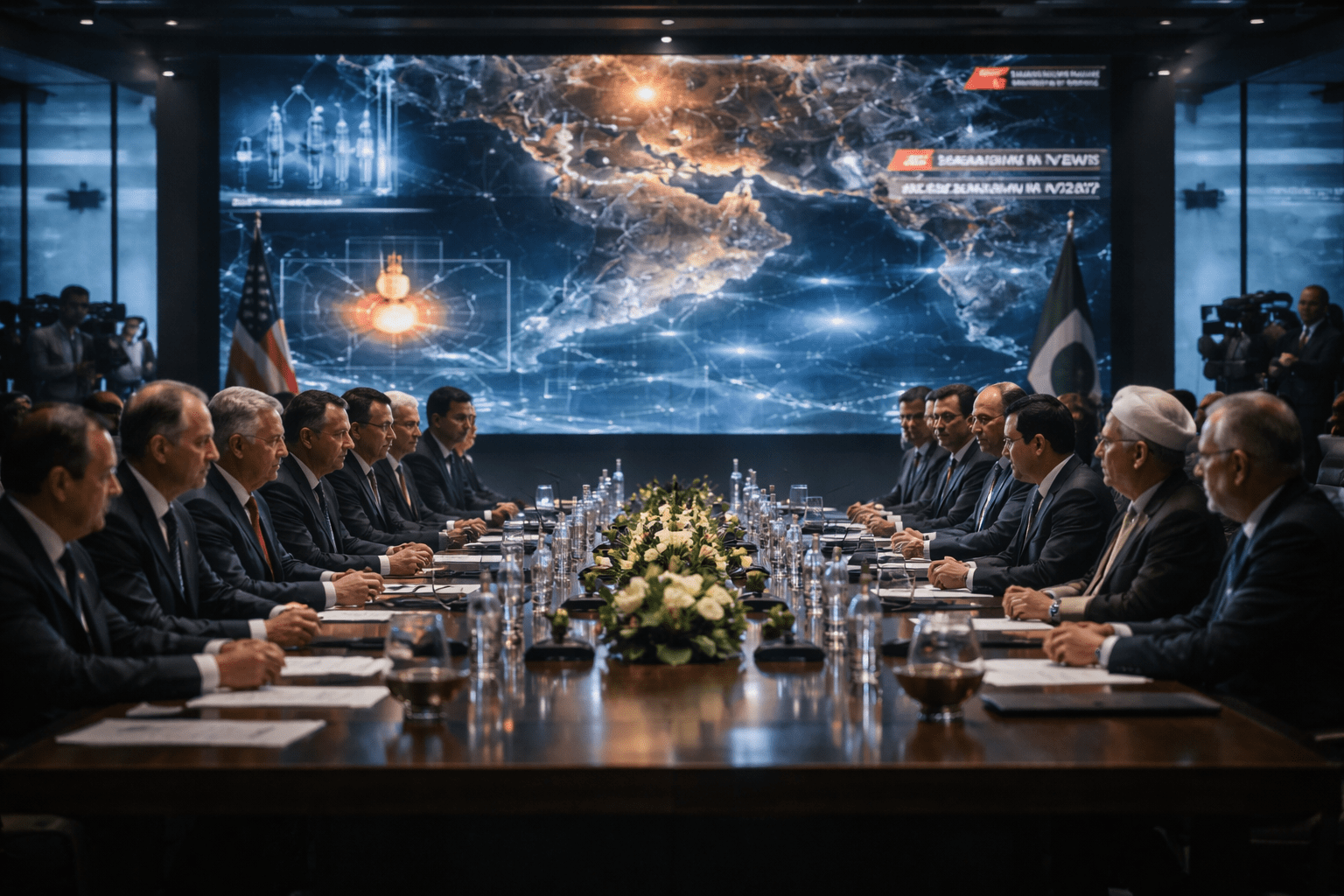
On April 11–12, 2026, the United States and Iran sat across from each other in Islamabad, Pakistan, for what became the most significant direct diplomatic engagement between the two countries since the 1979 Iranian Revolution. The setting was the Serena Hotel — an oasis of calm in Pakistan’s quiet capital city.
US Vice President JD Vance led the American delegation. Iran’s Parliament Speaker Mohammad-Baqer Ghalibaf headed the Iranian side. Pakistani Prime Minister Shehbaz Sharif hosted. For 21 straight hours, negotiators talked, argued, proposed, and counter-proposed. The talks included both indirect and direct exchanges — a first in decades.
“There really is, I think, a grand deal to be had here, but it’s up to the Iranians, I think, to take the next step.”
— US Vice President JD Vance, after leaving Islamabad
Yet, despite the historic nature of the setting, the Iran US nuclear talks collapsed without a memorandum of understanding. The gap between both sides was too wide on the central issue: uranium enrichment.
The Nuclear Enrichment Standoff: Where the Deal Broke Down
The central sticking point in the Iran US negotiations 2026 was the question of uranium enrichment — a core issue that has defined every round of diplomacy between these two nations for years.
| Issue | US Position | Iran’s Position |
|---|---|---|
| Uranium Enrichment Freeze | 20-year suspension demanded | Offered 3–5 years only |
| Highly Enriched Uranium (HEU) | Full removal from Iranian soil | Agreed to monitored “down blending” |
| Strait of Hormuz | Full reopening; joint US-Iran administration proposed | Rejected joint control; Iran-Oman waters only |
| Sanctions Relief | Lifting of sanctions offered in exchange for nuclear concessions | Demanded more frozen assets released upfront |
| Militant Group Funding | Must end support for regional militia | Non-negotiable sovereignty issue |
Iran’s Parliament Speaker Ghalibaf said the US delegation “ultimately failed to gain the trust of the Iranian delegation.” Iran, which had been bombed twice during the previous year of talks, wanted a guarantee that the war would truly end — not just a temporary ceasefire while making nuclear concessions. Iranian Foreign Minister Abbas Araghchi said both sides had come close to an understanding, but American negotiators had shifted their demands at the last moment.
For a deeper understanding of why the Strait of Hormuz is central to this entire conflict, read our detailed analysis: Why Is the Strait of Hormuz So Important? Top 10 Reasons That Could Change the World in 2026.
The US Naval Blockade of the Strait of Hormuz: A High-Risk Pressure Tactic

The US naval blockade of the Strait of Hormuz has added extreme pressure to the Iran-US ceasefire situation. Source: Unsplash
After the Islamabad talks ended without a deal, President Trump did something dramatic: he ordered a US naval blockade of the Strait of Hormuz — the narrow waterway through which roughly 20% of the world’s oil supply passes daily. The stated goal was to end what the White House called “Iranian extortion” and to prevent Tehran from using the Strait as leverage in the negotiations.
Iran’s Islamic Revolutionary Guard Corps (IRGC) responded immediately, warning that any US military vessel encroaching on the Strait of Hormuz would be treated as a ceasefire violation. The risk of renewed armed conflict is now dangerously high.
The blockade is also hammering oil markets. Crude prices have surged, putting pressure on American consumers and creating fresh urgency for a diplomatic solution. Trump’s own team reportedly does not want to resume full-scale war — partly because of rising domestic prices and public opposition. To understand what this means for energy markets and investment decisions, see our guide on Best Oil Stocks to Buy Now in 2026.
Who Is Mediating? The Diplomatic Push to Save the Iran US Deal
Behind the scenes, multiple countries are working overtime to prevent a return to war. Pakistan played the central role in arranging the Islamabad talks, and Pakistan’s military chief General Asim Munir has flown to Tehran carrying a new message from Washington. Meanwhile, Pakistan’s PM Sharif has begun a four-day diplomatic tour of Saudi Arabia, Qatar, and Turkey to rally regional support.
Iran and the US agree to a temporary halt in hostilities, creating a window for diplomacy.
Historic direct talks in Pakistan end without agreement on uranium enrichment.
Trump announces blockade of the Strait of Hormuz. Iran’s IRGC warns of ceasefire violation.
Trump says new talks could come “within days.” Pakistani, Turkish, and Egyptian mediators engage both sides.
General Asim Munir carries a new Washington message directly to Iranian leadership.
If no deal is reached, the ceasefire expires — and the war could resume.
Turkey’s President Erdogan said: “We are conveying the necessary suggestions and carrying out initiatives to ease tensions, extend the ceasefire and maintain talks.” Egypt and Qatar are also in active contact with both delegations. Turkey’s and Egypt’s foreign ministers held back-to-back phone calls with both White House envoy Steve Witkoff and Iran’s Araghchi on Sunday.
What Does Iran Want? Understanding Tehran’s Red Lines in the Nuclear Talks
Iran’s position in the Iran US nuclear deal 2026 negotiations is shaped by one core principle: sovereignty. Tehran maintains that its right to enrich uranium for civilian purposes is non-negotiable — it is a matter of national dignity and energy independence, not just geopolitics.
Iran’s Parliament Speaker Ghalibaf framed the US demands as an attempt to “achieve through negotiations what it did not achieve during the 40-day war.” Iran is also deeply suspicious of American intentions: the country was bombed twice during ongoing diplomatic processes, making any promise of peace difficult to trust without cast-iron guarantees.
It’s also worth noting that as recently as March 2025, US Director of National Intelligence Tulsi Gabbard testified to Congress that the United States “continues to assess that Iran is not building a nuclear weapon.” Yet Washington and Israel are pushing for complete restrictions on uranium enrichment, creating a credibility gap that has complicated every round of talks.
“We encountered maximalism, shifting goalposts, and blockade.”
— Iranian Foreign Minister Abbas Araghchi, after the Islamabad talks
What Does the US Want? Trump’s “Grand Bargain” on Iran Nuclear Deal
From Washington’s side, the Trump Iran nuclear deal proposal 2026 is remarkably ambitious. On the table for Iran: a full lifting of economic sanctions, international reintegration, and what Vice President Vance called “a very, very good deal for both countries.” In exchange, the US demands are steep:
- A 20-year suspension of uranium enrichment (US proposal)
- Complete removal of Iran’s stockpile of highly enriched uranium (over 400 kilograms)
- Dismantling of major nuclear enrichment facilities
- Full reopening of the Strait of Hormuz without toll-charging
- End to Iranian funding of regional militant groups
Russia has offered to take Iran’s enriched uranium stockpile as part of a potential deal — a proposal that has resurfaced in current negotiations. The US, however, is not keen on Russia playing a central role in a Middle East settlement.
The economic impact of this ongoing crisis is being felt globally. For investors watching how the Iran-US conflict is reshaping energy and emerging markets, our analysis on how people are adapting their income strategies in 2026 offers relevant context.
What Happens Next? 4 Scenarios Before the April 21 Ceasefire Expires

The next few days will determine whether the Iran-US conflict ends in diplomacy or escalation. Source: Unsplash
With the Iran US ceasefire 2026 set to expire on April 21, the world is now counting down. Here are the four most likely scenarios:
Scenario 1: A Second Round of Talks in Islamabad (Most Likely)
Trump confirmed on April 14 that new talks could happen “within days” and signaled Islamabad as the likely venue. Pakistan’s army chief traveling to Tehran is a strong signal that both sides are still serious. If a bridging formula can be found on enrichment duration — perhaps 10–15 years rather than 20 — a second round could happen before April 21.
Scenario 2: Ceasefire Extended Without a Full Deal
If talks resume but a final agreement remains out of reach, both sides might agree to extend the ceasefire for another few weeks. This is seen as a realistic fallback by regional diplomats, buying more time for negotiators to narrow the gaps.
Scenario 3: Talks Collapse and War Resumes
If no progress is made and the ceasefire expires, Trump has signaled he is considering resuming military strikes — potentially targeting Iranian infrastructure. Iran’s IRGC would almost certainly respond, pulling the region back into open conflict. This remains the most dangerous scenario.
Scenario 4: A Historic Deal — The “Grand Bargain”
The least likely but most consequential outcome is a comprehensive agreement: Iran limits its nuclear program in exchange for sanction relief and full international reintegration. Vance described this deal as achievable. The question is whether Iran’s leadership can accept the terms without losing face domestically.
Why the World Is Watching the Iran US Nuclear Deal in 2026
The stakes of the Iran US nuclear negotiations 2026 go far beyond the two nations involved. A successful deal would:
- Stabilize global oil prices — which have been volatile due to the Strait of Hormuz crisis
- Prevent nuclear proliferation — a key concern for the entire international community
- Reduce the risk of a wider regional war involving Saudi Arabia, Israel, and Hezbollah
- Open Iran’s vast economy to foreign investment after decades of sanctions
Conversely, a failure could trigger oil price spikes, a regional arms race, and a humanitarian catastrophe. The political dysfunction inside the US government adds another layer of uncertainty to an already volatile situation. For more context on global geopolitical instability and its economic consequences, leading experts at Council on Foreign Relations maintain a live tracker on this conflict, and BBC News’ Iran coverage provides continuous live updates.
DailyUpdates360 Analysis: Can Iran and the US Still Make a Deal?
The short answer is: yes, but it requires compromise that is politically painful for both sides.
The Islamabad talks revealed that despite the rhetoric, both sides genuinely want a resolution. Iran moved toward US demands on enrichment — even if not far enough. The US acknowledged progress. The fact that VP Vance and senior Iranian officials spoke face-to-face for 21 hours — something that hadn’t happened in nearly half a century — is itself a historic signal.
The mediators (Pakistan, Turkey, Egypt, Qatar) are all deeply motivated to prevent another war. They have the trust of both parties. Pakistan in particular has emerged as an unexpected but effective diplomatic power broker, leveraging its relationships with both Tehran and Washington to bring this moment about.
The window is narrow. The clock is ticking. But a deal is not impossible. Watch this space closely as April 21 approaches — the next 72 hours may define the next decade of Middle East history.

DailyUpdates360 World News Team
Our team covers geopolitics, global conflict, and world affairs with in-depth analysis and real-time updates. Follow our World News category for the latest.
❓ Frequently Asked Questions (FAQs) — Iran US Nuclear Talks 2026
What is the current status of Iran US nuclear talks in April 2026?
As of April 17, 2026, the first round of direct talks in Islamabad ended without a deal after 21 hours of negotiations. A second round is under discussion, with mediators from Pakistan, Turkey, and Egypt working to bridge the remaining gaps before the April 21 ceasefire deadline.
Why did the Iran US Islamabad talks fail in 2026?
The talks broke down primarily over Iran’s nuclear enrichment program. The US demanded a 20-year suspension and complete removal of Iran’s highly enriched uranium. Iran offered only a 3–5 year freeze, which was unacceptable to the Trump administration. Iran also cited a fundamental lack of trust given that it had been bombed twice during previous rounds of diplomacy.
What is the Strait of Hormuz blockade and why does it matter?
After the Islamabad talks stalled, President Trump ordered a US naval blockade of the Strait of Hormuz — a critical waterway through which about 20% of global oil supply flows. The blockade is a pressure tactic to prevent Iran from using the Strait as diplomatic leverage. Iran’s IRGC has warned that any US naval encroachment could be considered a ceasefire violation.
When does the Iran US ceasefire expire?
The two-week ceasefire, announced on April 7, 2026, is set to expire on April 21, 2026. Regional mediators are urgently trying to broker a second round of talks or at minimum an extension of the ceasefire before that deadline passes.
Who is mediating the Iran US peace talks?
Pakistan has been the primary mediator, hosting the landmark Islamabad talks and sending its military chief to Tehran. Turkey, Egypt, and Qatar are also actively facilitating diplomatic contacts between Washington and Tehran. Oman previously hosted earlier rounds of indirect talks.
What does Iran want from the nuclear deal negotiations?
Iran insists on its sovereign right to enrich uranium for civilian purposes. It wants an end to US sanctions, the release of frozen financial assets, and guarantees that the war will not restart once it makes nuclear concessions. It also rejects any joint administration of the Strait of Hormuz with the United States.
What does the US want from the Iran nuclear deal 2026?
The Trump administration wants a 20-year freeze on uranium enrichment, complete removal of Iran’s highly enriched uranium stockpile, dismantlement of major nuclear facilities, Iran to end funding for regional militant groups, and full reopening of the Strait of Hormuz.
Could the Iran-US conflict escalate after the ceasefire expires?
Yes. If no deal or extension is agreed before April 21, Trump has signaled he is considering resuming military strikes on Iran, potentially targeting infrastructure. Iran has warned it will respond to any US naval aggression. Regional experts describe this as one of the most dangerous flashpoints of 2026.