
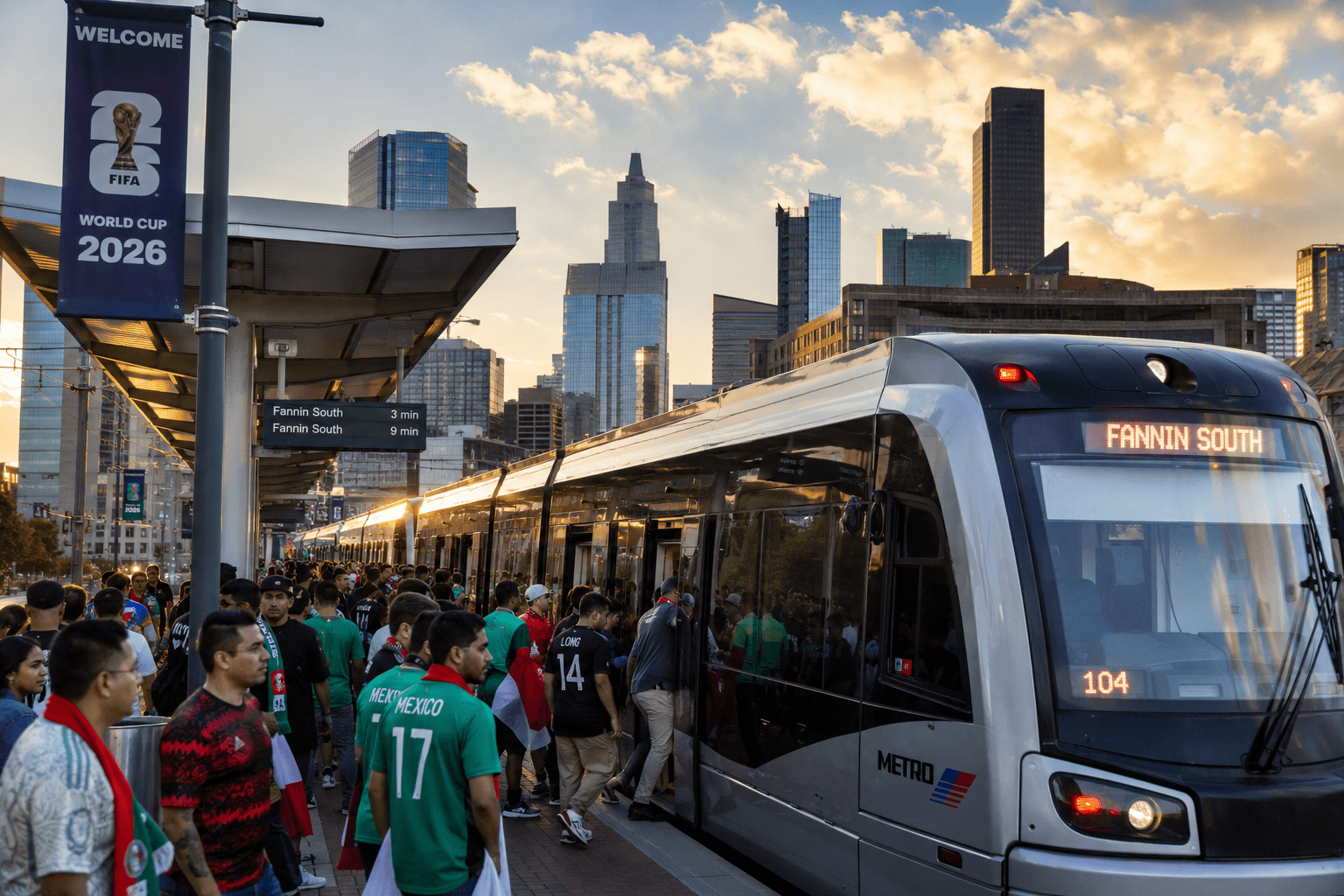
Getting to the stadium is half the battle. With the 2026 FIFA World Cup stretching across 16 cities in three countries — the United States, Canada, and Mexico — transportation planning isn’t just helpful, it’s essential. Millions of fans, many of them visiting North America for the very first time, will need to navigate unfamiliar subway systems, pre-book shuttle passes, and decode apps they’ve never heard of — all while trying not to miss kickoff.
The tournament kicks off June 12 in the U.S., with 78 matches across 11 American cities, culminating in the final on July 19 in New Jersey. Add the Canadian and Mexican host cities, and the logistical scope of this event is genuinely staggering. Smart Cities Dive
This guide breaks it all down. Whether you’re catching one group stage match or chasing the tournament across the continent, here’s what you need to know about getting around every 2026 FIFA World Cup host city.
Table of Contents
- Why Transit Planning Matters for the 2026 World Cup
- The $100 Million Federal Investment in Host City Transit
- U.S. Host City Transit Breakdown
- New York / New Jersey (MetLife Stadium)
- Los Angeles (SoFi Stadium)
- Dallas (AT&T Stadium)
- Seattle (Lumen Field)
- Philadelphia (Lincoln Financial Field)
- Kansas City (Arrowhead Stadium)
- Atlanta, Houston, Miami, Boston, San Francisco
- Canadian Host Cities: Vancouver and Toronto
- Mexican Host Cities: Mexico City, Monterrey, Guadalajara
- Parking at World Cup Stadiums
- Rideshare Reality Check
- Pro Tips for Navigating Match Day
- FAQs
Why Transit Planning Matters More Than You Think
The 2026 World Cup isn’t like attending a game at your local club. It stretches across 104 matches in 16 host cities from June 11 through July 19, with the Final at MetLife Stadium in New York/New Jersey. For many fans, the real challenge isn’t getting tickets — it’s coordinating airport arrivals, stadium access, and post-match departures without losing hours in traffic or paying through the roof for a last-minute rideshare. True North VIP
International and out-of-town visitors may be unfamiliar with each host city’s transit system, and transit agencies may need to plan for additional trains, buses, and operators. Cities will also have to manage traffic congestion, drop-off and pickup locations for ride-hailing vehicles, and heightened security. Smart Cities Dive
The good news? Most host cities have been preparing seriously — some have built entirely new infrastructure just for this event.
The $100 Million Federal Investment in Host City Transit
Before diving city by city, it’s worth knowing that significant money has been committed to making this work. The U.S. Department of Transportation announced a $100 million investment to help public transit systems in host cities prepare for the 2026 FIFA World Cup, awarded through the Federal Transit Administration (FTA), intended to assist local transit agencies with planning, capital improvements, and operating expenses as they prepare for large influxes of visitors. aol
The U.S. House passed this $100 million funding to help transit agencies cover costs associated with hosting the FIFA World Cup 2026. Each host city will not only manage the matches themselves, but also the daily celebrations and movement of tens of thousands of visitors, with each stadium required to be supported by a nearby airport capable of handling at least 1,450 passengers per hour. house
That’s a meaningful commitment — and it’s already showing up in real infrastructure upgrades, as you’ll see below.
U.S. Host City Transit Breakdown
New York / New Jersey — MetLife Stadium
MetLife hosts the biggest prize: the World Cup Final on July 19, 2026. That makes New York and New Jersey the epicenter of the tournament’s transport pressure. True North VIP
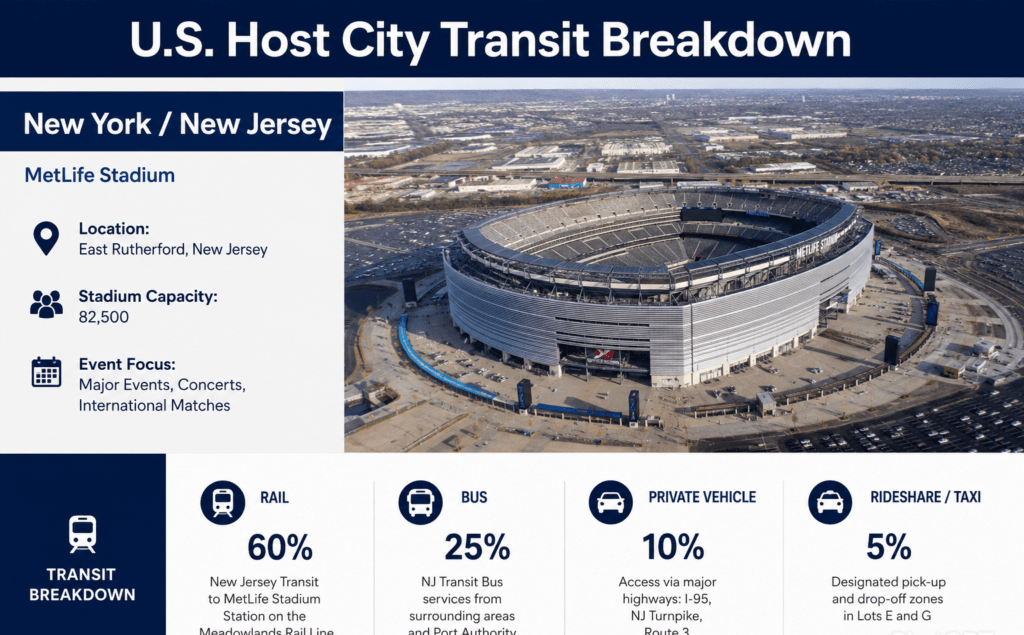
NJ Transit tickets are capped at 40,000 per match and must be pre-purchased via the NJ Transit app. A physical wristband is required for the return journey. Walking to MetLife Stadium is banned — pedestrian traffic is prohibited on surrounding roadways. Wego Travel Blog
The round-trip fare for match-ticket holders from Penn Station has been set at $150 — a price point that drew significant criticism. New Jersey Governor Mikie Sherrill said “FIFA should pay” for transport, a day before NJ Transit confirmed the $150 round-trip fare from Penn Station to MetLife Stadium. ESPN
To manage the enormous expected crowds, NJ Transit’s board awarded a contract worth up to $3.4 million to provide bus service shuttling fans between Secaucus Junction Station and MetLife Stadium. On the day of the final, there will be 125 buses on standby, and the combined bus and train service is expected to transport at least 20,000 people per hour. aol
Bottom line: Book your NJ Transit tickets the moment they go on sale. Don’t plan to walk, and don’t assume a rideshare will be available post-match.
Los Angeles — SoFi Stadium
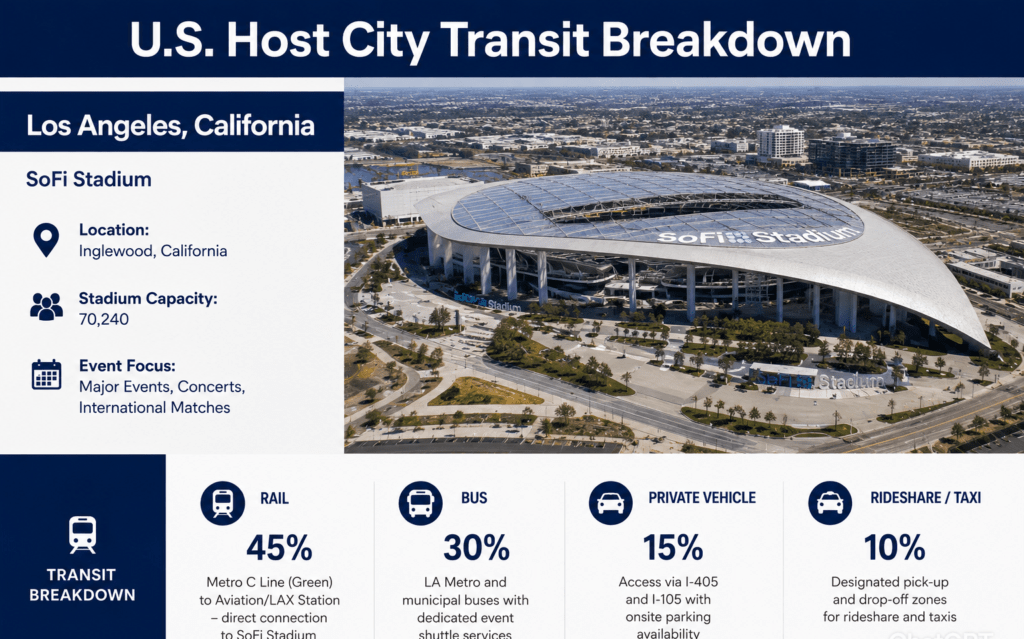
Los Angeles County Metro will open a subway extension in time for the World Cup matches. LA Metro offers an affordable round-trip option at just $3.50. Given LA’s notorious traffic, the Metro extension is genuinely the smart move — leave the car at home and ride in on rail. Smart Cities DiveWego Travel Blog
Expect road closures around SoFi on match days, and note that rideshare drop-off and pickup zones are not at the stadium gate. A 20–30 minute walk from rideshare zones to venues like SoFi is standard, and surge pricing on Uber and Lyft post-match will be significant. Wego Travel Blog
Dallas — AT&T Stadium
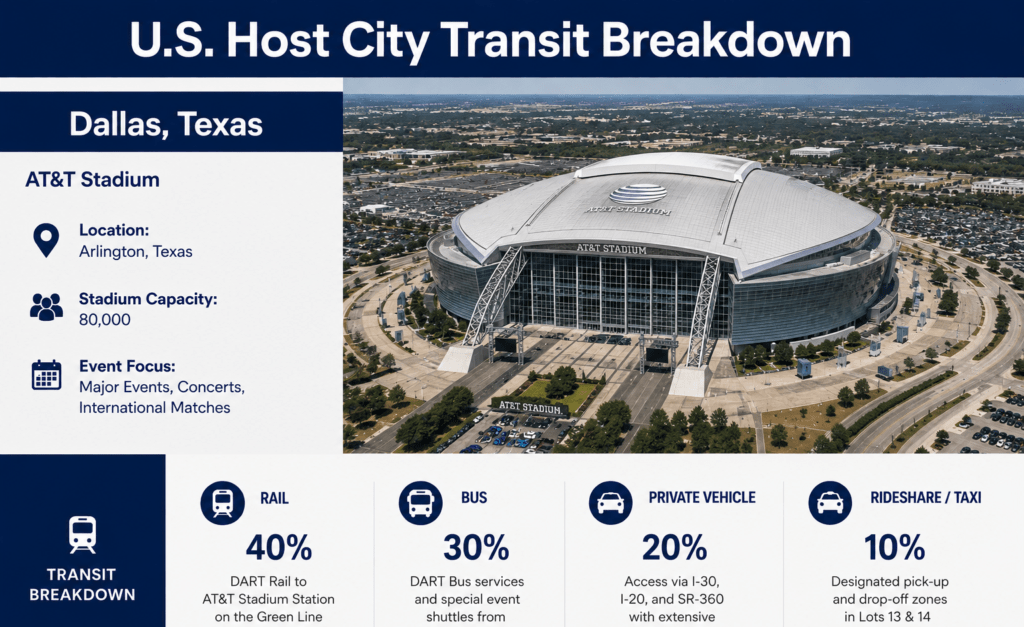
AT&T Stadium in Arlington has limited traditional public transit, but match-day shuttle services are in place. Dallas has announced fan-friendly transport pricing for the tournament. DART (Dallas Area Rapid Transit) provides rail service into the broader Dallas-Fort Worth area, and dedicated game-day shuttles will connect major transit hubs to the stadium. Fares are expected to stay reasonable — generally under $6 each way. ESPN
Given that Dallas and Atlanta host the semifinals, this city will see some of the tournament’s highest-pressure travel days.
Seattle — Lumen Field
It is one of the smoothest transit stories of the entire tournament. Seattle completed the final segment of its light rail line to bring riders directly to the downtown stadium. Smart Cities Dive
Sound Transit’s Link Light Rail serves Lumen Field, and a special ORCA 3-Day World Cup Pass costs $18 and covers unlimited rides across the entire regional network. That’s exceptional value for multi-day visitors, and the light rail runs from the airport all the way downtown — making it a seamless experience from the moment you land. Wego Travel Blog
Philadelphia — Lincoln Financial Field
It’s stands out as the most fan-friendly transit story of the entire tournament. Philadelphia is offering free rides home on SEPTA’s Broad Street Line after all six matches from NRG Station, which serves the South Philadelphia Sports Complex. The services begin at halftime and continue for two hours after each match. ESPN
SEPTA confirmed there will be no fare increases connected to the staging of World Cup matches in Philadelphia, with most added operating costs covered by a federal grant. ESPN
Philadelphia is set to host matches featuring Brazil and France in the group stage, as well as a round-of-16 match on the July 4th holiday. The city’s combination of low fares, free post-match returns, and straightforward transit routing makes it the most accessible venue in the U.S. ESPN
Kansas City — Arrowhead Stadium
Kansas City’s transit situation is perhaps the most fascinating of the entire tournament. The city had almost no usable public transit to speak of before this event — so they built a new one.
GEHA Field at Arrowhead Stadium will serve as “Kansas City Stadium” for the tournament, hosting four group stage matches, one Round of 32 game, and one quarterfinal. NPR
Kansas City will offer free bus travel for fans from the airport to the Fan Festival in the city center, and daily, weekly, and tournament passes for unlimited regional travel costing $5.25 and $50, respectively. Ticket holders will also be able to use a Stadium Direct service connecting four park-and-ride locations as well as the Fan Festival to Arrowhead Stadium for $15 per person. ESPN
The transit authority has framed this investment as something that benefits the city long after the final whistle. A spokesperson for the planning committee noted that “costs will be in the millions,” and Kansas City confirmed it pledged $15 million to meet World Cup obligations. NPR
Atlanta, Houston, Miami, Boston, and San Francisco
Atlanta redesigned its bus network and launched a new bus rapid transit line. MARTA rail connects the city well, and fares to Mercedes-Benz Stadium are competitive. Smart Cities Dive
Houston’s NRG Stadium is served by METRORail’s Red Line. Los Angeles, Atlanta, and Houston have locked in regular fares for the tournament. Miami’s Hard Rock Stadium is more car-dependent, though shuttle services will be available. Boston’s Gillette Stadium is served by commuter rail from South Station. San Francisco/Bay Area fans should note that Levi’s Stadium in Santa Clara is 45 miles from the city — plan ahead with Caltrain or VTA light rail connections. TheStreet
Canadian Host Cities: Vancouver and Toronto
Vancouver and Toronto are among the Canadian host cities for the 2026 FIFA World Cup. Geo News
Vancouver (BC Place): TransLink’s SkyTrain network connects the airport, downtown, and BC Place efficiently. Stadium Station sits directly adjacent to the venue — it’s one of the easiest transit experiences in the entire tournament. Get a Compass Card and load it up before match day.
Toronto (BMO Field): TTC streetcars serve the Exhibition grounds well, and GO Transit provides regional rail access from the suburbs. Game-day service is typically enhanced for major events.
For cross-border travel, NEXUS cards expedite the Seattle–Vancouver crossing significantly. If you’re planning to attend matches in both cities, that card is worth the application. True North VIP
Mexican Host Cities: Mexico City, Guadalajara, Monterrey
Mexico City’s Estadio Azteca is one of the most storied football grounds in the world, and the city’s Metro system — one of Latin America’s largest — provides solid access. Line 2 runs near the stadium, and additional services are expected on match days.
Guadalajara’s Estadio Akron is served by Guadalajara’s Tren Ligero light rail. For Monterrey at Estadio BBVA, the Metrorrey system provides the core public transit option, though the stadium’s location means some fans will rely on shuttle services.
For international visitors to Mexico, note that local transportation apps like Cabify and InDriver often compete well on price with Uber in Mexican cities.
Parking at World Cup Stadiums
If you absolutely must drive, know the rules now — not on match day. Parking needs to be booked ahead of time via FIFA’s official JustPark app. No on-site payments are accepted, and your JustPark email must match your FIFA ticketing account. Geo News
Parking prices range from $75 for group-stage matches at AT&T Stadium to over $250 at MetLife and SoFi for knockout rounds. For comparison, public transit to the same venues costs a fraction of that — making transit the clear winner on cost. Wego Travel Blog
Rideshare Reality Check
Rideshare apps like Uber and Lyft will be active across all U.S. host cities, but managing expectations here is important. Surge pricing post-match will be significant, and rideshare pickup zones are often a 20–30 minute walk from the stadium itself. Wego Travel Blog
Pre-booking a car service for key matches — especially the semifinals and Final — is genuinely worth considering. After 60,000+ fans pour out of a venue simultaneously, the rideshare market goes haywire. If budget allows, locking in a confirmed vehicle in advance removes that headache entirely.
Pro Tips for Navigating Match Day
- Download transit apps before you travel. NJ Transit, LA Metro, Sound Transit, SEPTA, and TransLink all have dedicated apps. Set them up at home, not on the day.
- Get city transit passes. Seattle’s ORCA 3-Day Pass and Kansas City’s tournament pass offer real value for multi-day visitors.
- Arrive early, leave late. The worst congestion hits in the 30 minutes after final whistles. Grab food nearby and let the crowd thin before heading to the station.
- Check official city sites for updates. Public transport details keep changing, so check the official host city sites prior to match day. Geo News
- For New York: the wristband is non-negotiable. NJ Transit requires a physical wristband for the return journey — don’t assume a ticket is enough.
- Cross-border fans: Carry valid travel documents and check visa requirements for all three host nations. ESTA or visitor visas may be required depending on your nationality.
Wrapping Up
The 2026 FIFA World Cup is the largest football tournament ever staged. Getting around it requires real preparation — but the infrastructure is better than many skeptics expected. From Seattle’s completed light rail extension to Philadelphia’s post-match free trains, from Kansas City’s entirely new transit system to the $100 million federal investment flowing through host cities, there has been genuine effort to make this work for fans.
The biggest pitfalls are avoidable: book NJ Transit early, skip the car in Los Angeles, get the ORCA Pass in Seattle, and never rely on post-match rideshare surge pricing without a backup plan. Plan ahead and the transit experience can actually enhance the tournament, not detract from it.