
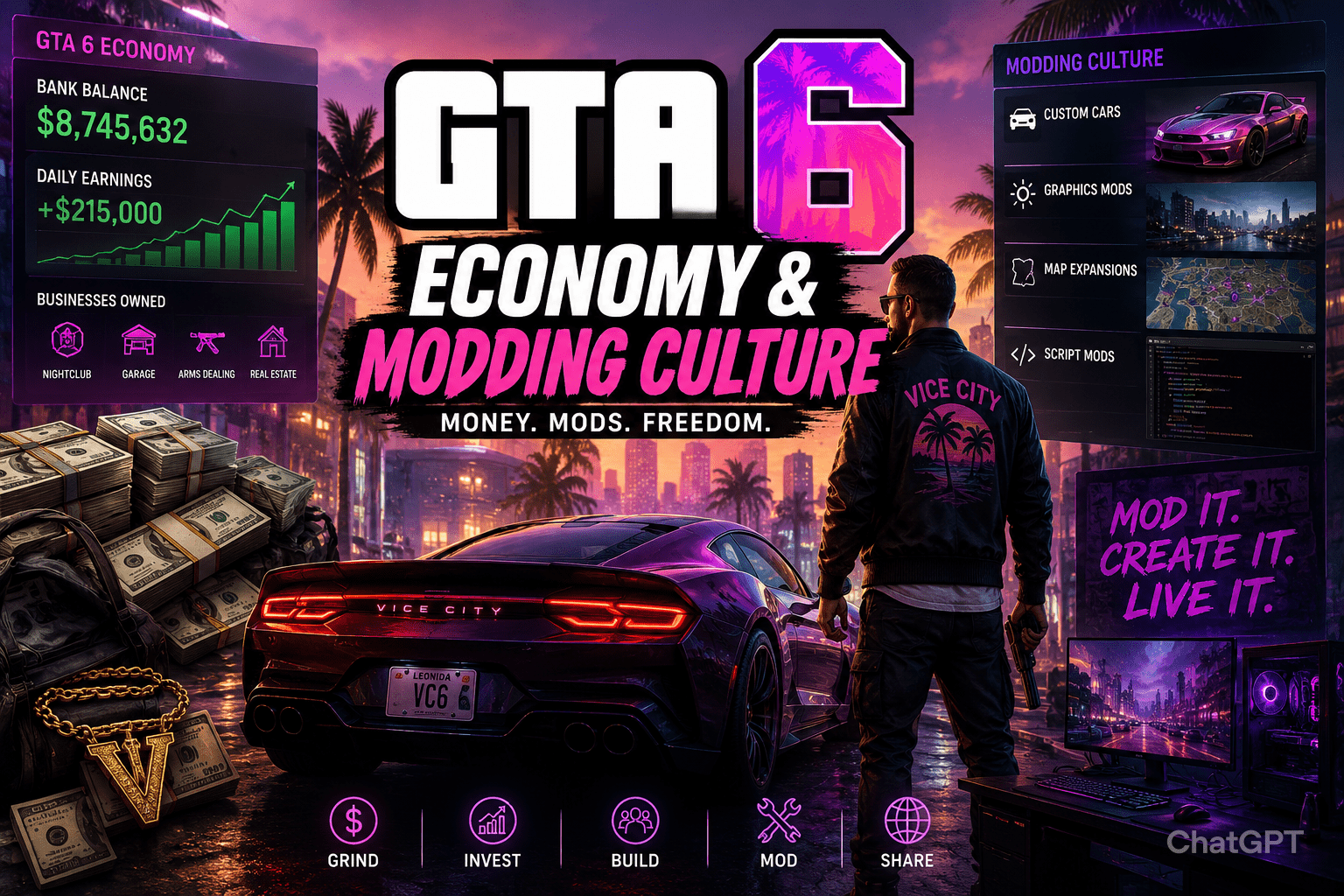
Vice City’s Virtual Economy, Billion-Dollar Stakes, and the Modders Who Shape the Game
- Introduction — Why GTA 6’s Economy Matters
- GTA 6’s In-Game Economy: What We Know
- GTA Online’s Blueprint and What Changes in GTA 6
- The Real-World Money Behind Virtual Crime
- The Modding Culture: A History
- GTA 6 Modding Landscape: Challenges & Opportunities
- Rockstar vs. Modders: An Uneasy Relationship
- Frequently Asked Questions
- Conclusion
Why GTA 6’s Economy Matters
When Rockstar Games dropped the first official GTA 6 trailer in December 2023, the internet didn’t just react — it detonated. Within 24 hours, the trailer had accumulated over 90 million views on YouTube, breaking records and confirming something the gaming world already suspected: Grand Theft Auto 6 isn’t just a video game release. It’s a cultural and economic event of the first order.
But beyond the sun-soaked beaches of Leonida, the return to Vice City, and the dual protagonists of Jason and Lucia, a quieter conversation has been unfolding among economists, game designers, and the sprawling community of GTA modders. That conversation is about money — virtual money, real money, and the cultural ecosystem that has grown up around both.
GTA Online, the multiplayer component of GTA 5, generated an estimated $1 billion in annual revenue for years after launch — dwarfing the single-player game’s already massive earnings. Shark Cards, in-game currency, and the shadow economy of player-driven markets created an entire financial ecosystem inside a crime simulator. GTA 6 is poised to inherit, evolve, and potentially transform all of that.
Meanwhile, the modding community — the tens of thousands of developers, artists, and enthusiasts who rewrite the rules of Rockstar’s world — sits at a crossroads. Will GTA 6’s platform support or suppress the creative underground that has kept GTA 5 alive for over a decade? That question has no easy answer, and this piece explores both sides of it.

GTA 6’s In-Game Economy: What We Know
Rockstar has been characteristically tight-lipped about specific mechanics, but the trailers, leaks, and industry analysis give us a reasonable picture of what GTA 6’s economy might look like — and why it will be more sophisticated than anything the series has attempted before.
GTA 5 Total Revenue
Copies Sold
Annual GTA Online Revenue
GTA 5 Longevity
A Living, Breathing Economic World
The trailer footage and leaked gameplay suggest Vice City’s economy in GTA 6 will feel more dynamic and reactive than in previous entries. Properties, businesses, and criminal enterprises appear to operate on systems that respond to player behavior — prices fluctuate, opportunities open and close, and the social simulation layer seems dramatically deeper.
Dynamic Business Ownership
Players are expected to purchase, manage, and grow businesses ranging from nightclubs to legitimate-front enterprises — each with revenue streams that interact with the broader in-game economy. Neglect a business, and rivals move in. Invest strategically, and compound returns follow.
Property Markets
Vice City’s real estate appears to function as a genuine investment system. Safe houses, commercial properties, and criminal operations are expected to generate passive income, creating long-term economic planning as a core gameplay loop — a significant evolution from GTA 5’s simpler property mechanics.
NPC Economic Simulation
The NPCs of Leonida aren’t just pedestrians — they’re economic agents. Leaked details suggest they carry money, engage in commerce, and respond to the economic conditions of their districts. Rob a bank in a poorer neighborhood, and you destabilize local commerce. This creates emergent storytelling through economic cause and effect.
Dual Protagonist Economics
Playing as both Jason and Lucia creates an interesting dual-economy dynamic. Each character may have different financial strengths, access levels, and economic relationships — forcing players to think about resource allocation across two characters with distinct criminal skill sets and social networks.
“GTA 6 isn’t just going to simulate crime. It’s going to simulate the economy that crime operates within.”
— Gaming analyst, IGN Feature, 2024
GTA Online’s Blueprint and What Changes
To understand where GTA 6 Online is going, you have to understand where GTA Online has been. Launched as a modest companion to GTA 5 in 2013, GTA Online evolved into one of the most profitable live-service games in history — and a case study in how virtual economies develop their own rules, cultures, and shadow markets.
The Shark Card Economy
Rockstar’s Shark Cards — real money purchases of in-game currency — became the financial backbone of GTA Online. Players could grind for hundreds of hours to buy the most expensive vehicles and properties, or pay real money to shortcut the process. The system was controversial but extraordinarily profitable.
- Megalodon Shark Card: $100 real money for 8,000,000 GTA$ — highlighting the scale of the virtual economy
- Inflation dynamics: Rockstar regularly added content priced above what free players could reasonably earn, pressuring Shark Card purchases
- Player resistance: Communities developed sophisticated money-grinding strategies, tutorials, and tools to avoid paying real money
- Modded lobbies: A thriving underground of money-drop mods and hacked lobbies created a parallel economy that Rockstar fought for years
What GTA 6 Online Needs to Do Differently
The lesson of GTA Online isn’t that monetization is bad — it’s that perceived fairness matters enormously. When players feel the economy is rigged against them, they either disengage or find workarounds. GTA 6 Online will likely attempt a more balanced approach, possibly incorporating:
Expected Improvements
- More accessible earning rates for free players
- Cosmetic-focused microtransactions
- Collaborative heist economics
- Real-estate & business passive income
- Social trading between players
Potential Friction Points
- Griefer culture in open lobbies
- Pay-to-win perception risk
- Currency inflation over time
- Cross-platform economy balance
- Anti-cheat pressure on modders
Analysts at Bloomberg and The Verge have estimated that GTA 6 Online could generate $2–3 billion annually if it successfully captures the player base of GTA Online while addressing its most criticised economic friction points. That makes the economy design arguably as important as any gameplay mechanic.
The Real-World Money Behind Virtual Crime
It sounds paradoxical: a game about stealing money has become one of the most reliably profitable entertainment products in history. But GTA’s financial success isn’t just a gaming story — it’s a story about how virtual economies interact with real ones.
Take-Two Interactive’s Financial Dependency
Parent company Take-Two Interactive has been, for years, financially dependent on GTA Online’s live-service revenue in ways that shaped corporate strategy. When GTA Online revenue declined during non-update periods, Take-Two’s stock felt the pressure. GTA 6’s successful launch — and the health of its online economy — is a matter of serious financial consequence beyond the gaming industry.
The Grey Market: Real Money for Virtual Currency
Outside of Shark Cards, an entire grey market developed around GTA Online’s economy. Players sold modded accounts, in-game cash, and rare items for real money through third-party platforms. Rockstar has consistently battled this — banning accounts, pursuing modders legally — but the grey market persisted because the demand was real.
This phenomenon reflects something important: when a virtual economy is compelling enough, players assign it real-world value. They spend real hours earning virtual currency, which means that currency represents real labor — and the market responds accordingly. GTA 6 will inherit this dynamic, and how Rockstar manages it will define a significant portion of the game’s cultural legacy.
“Players don’t buy Shark Cards for the money. They buy back time. That’s the real product Rockstar is selling.”
— Games economist, GDC Talk, 2022
Influencer & Content Creator Economics
A secondary real-world economy has grown up around GTA — the content creator ecosystem. YouTubers and streamers building GTA content generate millions of views and significant ad revenue. This ecosystem, worth hundreds of millions of dollars annually across creators, is itself financially dependent on GTA’s continued vitality. GTA 6’s launch will trigger one of the largest content creation events in gaming history, with economic consequences that ripple well beyond Rockstar’s own revenue.
The Modding Culture: A History
Before we get to GTA 6, it’s worth understanding what modding means in the context of GTA — because it means something quite different here than in most other franchises.
FiveM: The Modding Success Story
No discussion of GTA modding culture is complete without acknowledging FiveM — the custom multiplayer framework that became home to thousands of roleplay servers and communities. FiveM took GTA 5’s world and transformed it into a platform for entirely different games: police roleplay, city government simulations, economy-driven survival servers, and more.
At its peak, FiveM was hosting over 250,000 concurrent players — and Rockstar eventually acquired the company behind it (Cfx.re) in 2023, a remarkable reversal that signaled recognition of modding’s legitimate value. This acquisition is one of the most important signals we have about how Rockstar might approach GTA 6 modding.
GTA 6 Modding: Challenges & Opportunities
The modding community faces GTA 6 with a mixture of excitement and anxiety. The excitement is obvious — a new Rockstar world is a new canvas. The anxiety stems from years of complicated history and genuine uncertainty about what Rockstar will permit.
Technical Challenges
GTA 6’s scale — a map reportedly significantly larger than GTA 5’s, with dynamic weather, richer NPC systems, and more complex traffic and physics simulation — means that modding it will require tools of proportional sophistication. The community will need new versions of Script Hook, new model editors, and new understanding of Rockstar’s updated RAGE engine.
- RAGE Engine complexity: Each GTA iteration requires reverse-engineering a more complex engine from scratch
- Anti-cheat integration: Rockstar’s expanded anti-cheat systems will make online modding significantly harder
- Console vs. PC gap: Console players have never had access to mods — PC will remain the modding platform
- Asset scale: More assets, more detail, and more dynamic systems mean more to understand before meaningful mods can be built
- Legal uncertainty: Rockstar’s DMCA enforcement history creates legal risk for public mod creators
Opportunities the Modding Community Is Anticipating
Despite the challenges, the opportunities are enormous. GTA 6’s expanded world, richer NPC simulation, and deeper economic systems give modders more to work with than ever before.
Total Conversion Potential
Just as GTA 5 became the base for games-within-games via FiveM, GTA 6’s richer simulation layer could support even more sophisticated total conversions — persistent online worlds, economy simulations, and entirely new game modes built on Rockstar’s infrastructure.
Roleplay Server Evolution
GTA 6’s deeper NPC economics and social simulation could make roleplay servers more immersive than ever. The systems that make Vice City feel alive could also make a player-run city simulation feel genuinely consequential.
Visual & Map Mods
Realistic graphics mods, expanded map additions, and environmental overhauls have always been among GTA modding’s most downloaded content. GTA 6’s more photorealistic baseline is actually an invitation — the gap between stock and modded visuals may be smaller, but the ceiling for what’s achievable is higher.
The modding community at GTAForums.com, which has been active since 2002, has already begun preliminary discussions about GTA 6 modding infrastructure. Expect the first script hook attempts within weeks of PC launch — the community’s technical capability has grown dramatically with each generation.
Rockstar vs. Modders: An Uneasy Truce
The relationship between Rockstar and the modding community is one of the most fascinating and frustrating dynamics in gaming. It has oscillated between tacit tolerance, aggressive legal action, and — most recently — outright acquisition.
The OpenIV Incident
In 2017, Rockstar issued a cease-and-desist to OpenIV — the primary tool for creating single-player mods for GTA 5. The gaming community’s response was furious. Negative Steam reviews flooded in. Rockstar reversed course within days, issuing a clarification that OpenIV would be permitted for single-player use only. The incident crystallized the community’s understanding of where the line was drawn: single-player mods are tolerated; anything that touches GTA Online is not.
The FiveM Acquisition: A New Chapter
The 2023 acquisition of Cfx.re — the company behind FiveM and the roleplay server ecosystem — changed the calculus entirely. Rather than fighting the modding community, Rockstar recognized the value they had created and brought them inside the tent. This is arguably the most significant event in GTA modding history, and its implications for GTA 6 are profound.
If Rockstar officially supports FiveM-style servers for GTA 6, it creates a legitimate framework where modders can build communities without legal fear. The economic model becomes clearer too — modders who run servers could potentially monetize through Rockstar’s own approved channels rather than grey market Patreon arrangements.
Rockstar’s Red Lines
- GTA Online economy manipulation
- Money drop mods & cheating tools
- Unauthorized IP reproduction
- Mods that damage other players
- Commercial mods using GTA IP
Historically Tolerated
- Single-player experience mods
- Visual & graphics overhauls
- Vehicle & model replacements
- Story & mission mods (offline)
- Roleplay servers (post-2023)
What the Community Wants from GTA 6
The modding community’s wishlist for GTA 6 is clear and surprisingly unified: official mod support tools, a clear legal framework, and an online environment that separates modded servers from the base GTA Online economy. If Rockstar provides these things — even in limited form — the modding community will build an ecosystem around GTA 6 that extends its commercial life by another decade.
The business case for this is obvious. Every year a modder keeps a player engaged with GTA 6 is a year that player might buy a Shark Card, purchase DLC, or recruit new players to the platform. The modding community doesn’t undermine GTA’s economy — in the long run, they extend and deepen it.
Vice City’s Dual Economy
GTA 6 exists at the intersection of two economies — the virtual one playing out on the streets of Leonida, and the very real one playing out in Take-Two’s quarterly reports, modders’ Patreon pages, and content creators’ ad revenue dashboards.
The in-game economy represents Rockstar’s most ambitious simulation yet: a Vice City where money flows, businesses breathe, and every criminal decision has economic consequences. The modding economy represents a parallel act of creation — a community that has consistently extended, deepened, and enriched Rockstar’s work far beyond its commercial life expectancy.
Whether Rockstar chooses collaboration or conflict with its modding community may prove to be as consequential as any design decision in the game itself. The history of GTA suggests both are possible. The FiveM acquisition suggests a wiser path is being chosen. Either way, the conversation between game makers and game breakers — between official economies and underground ones — will be one of GTA 6’s most compelling stories.
And that story hasn’t even started yet.
Gaming Economy
Modding Culture
GTA Online
FiveM
Rockstar Games
Vice City
Live Service