
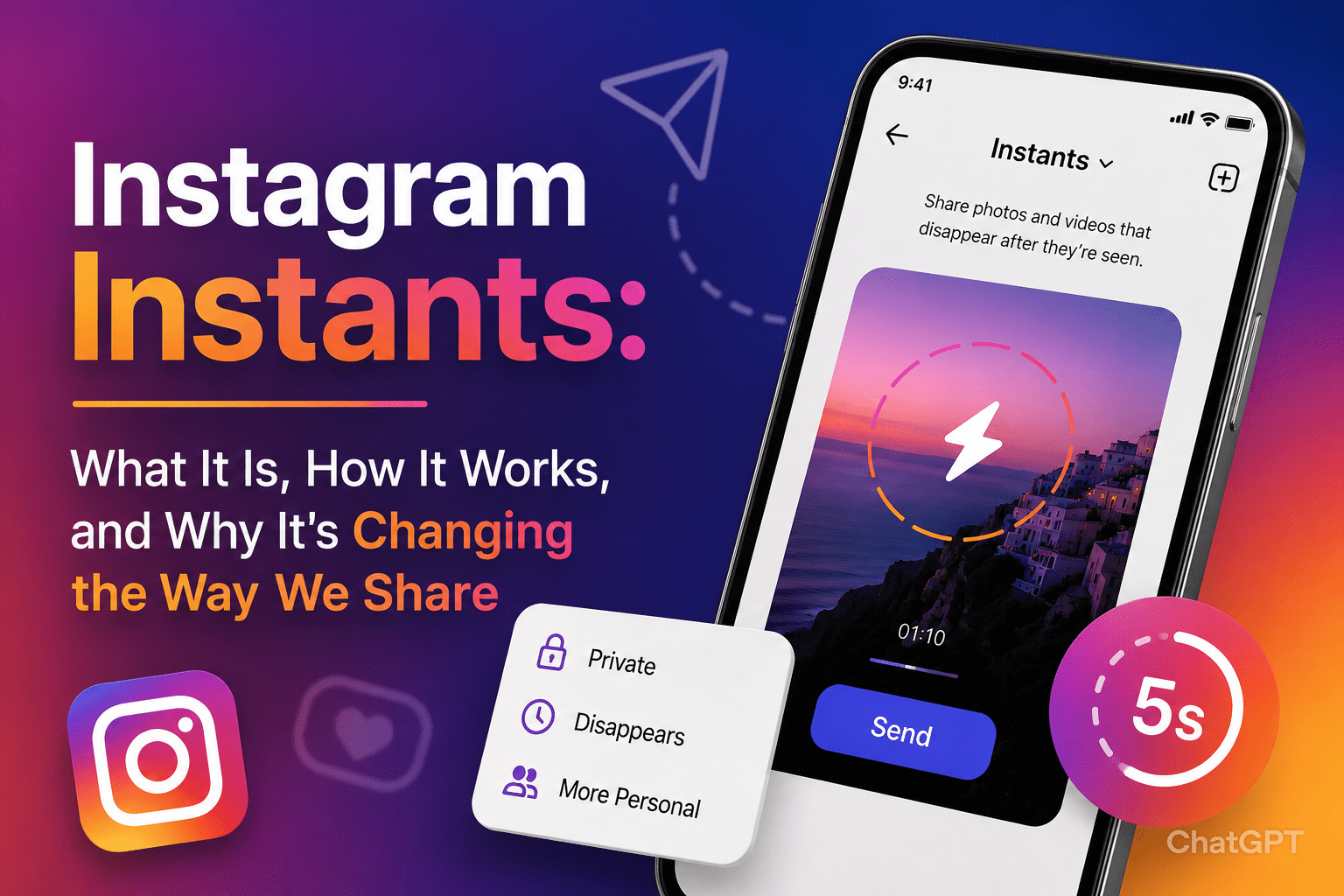
There’s a quiet shift happening on Instagram — and if you’ve noticed your feed feeling more alive, more in-the-moment, there’s a reason for that. Instagram Instants is the platform’s push toward frictionless, real-time content sharing: the idea that the gap between experiencing something and sharing it should be as close to zero as possible.
Whether you’re a casual scroller, a brand strategist, or a content creator trying to stay ahead of every platform update, understanding Instagram Instants isn’t optional anymore. It’s becoming foundational to how Instagram works — and how audiences expect to experience it.
This piece breaks down exactly what Instagram Instants is, how the feature functions across different content types, and what it means for anyone who uses Instagram seriously.
What Are Instagram Instants?
At its core, Instagram Instants refers to a suite of real-time and near-real-time content features on Instagram designed to capture and share moments with minimal editing or delay. Think of it as Instagram leaning hard into authenticity — the BeReal effect, applied at scale to one of the world’s largest social platforms.
The term encompasses several overlapping features and behaviors on the platform:
- Instant Stories: Stories published immediately from the camera with no queued edits
- Live collaboration tools: Joint Lives and real-time co-streaming
- Candid Challenges: Instagram’s prompt-based candid photo feature (their answer to BeReal)
- Notes and Quick Reactions: Ephemeral text that disappears within 24 hours
- Close Friends real-time sharing: Targeted immediate posts to a curated inner circle
Instagram has been iterating aggressively on this space. According to Meta’s official Newsroom, the company has repeatedly stated that authentic, unfiltered sharing is the next major growth frontier — particularly among Gen Z users who find heavily produced content less relatable.
Why Instagram Is Doubling Down on Real-Time Sharing
You can’t understand Instagram Instants without understanding the competitive landscape that forced it into existence.
When BeReal launched and briefly went viral in 2022–2023, it exposed something Instagram’s internal teams already suspected: polished content was starting to fatigue younger audiences. The whole premise of BeReal — you get two minutes to take a photo, front camera and back camera simultaneously, no filters — resonated because it felt honest. Instagram, famously associated with aesthetic perfection, had a credibility problem with the very demographic it needed most.
Meta’s response was layered and deliberate. They didn’t just copy BeReal outright (though the Candid Challenges feature is clearly inspired by it). They built a broader philosophy around immediacy — one that touches Stories, Reels, DMs, and even how the algorithm surfaces content.
The Pew Research Center has documented this shift in teen behavior: younger users increasingly prefer platforms that feel spontaneous over those that reward production value. Instagram is responding directly to that data.
How Instagram Instants Features Actually Work
Candid Challenges
This is the most visible face of Instagram Instants. When you receive a Candid Challenge notification, you have a limited window to take a simultaneous front-and-back camera photo. You can’t pre-take it. You can’t filter it. It gets posted to your Close Friends Story automatically.
The mechanic is deliberately low-friction. No crop tool. No filter carousel. The whole point is that the image is timestamped to now — not to whenever you decided a photo was good enough to post.
Instant Stories and the Camera-First Workflow
Instagram has quietly redesigned its camera interface to nudge users toward posting immediately rather than sitting on content. The “Add to Story” button is now the default post-capture option on mobile. Story drafts are still available, but the UX hierarchy clearly favors publishing instantly.
This is a small design decision with enormous behavioral implications. Defaults shape behavior — and Instagram’s defaults are now pushing toward immediacy.
Notes: The Ephemeral Status Update
Instagram Notes is a feature that lets users post short text updates (up to 60 characters) that sit at the top of their followers’ DM inboxes and disappear after 24 hours. It’s closer to an AIM away message than anything else Instagram has ever built.
What makes Notes relevant to Instants is its intentional lack of permanence. There’s no like count. No comment thread. It exists purely in the moment — which is, increasingly, the aesthetic Instagram is cultivating.
Real-Time Engagement Through Live and Collab
Instagram Live was already real-time by definition, but the platform has added collaboration layers that make it feel more like a genuine shared experience. Dual Lives, Q&A integrations, and real-time reactions have all been upgraded. Brands and creators are using these tools to run product launches, AMAs, and community events that feel genuinely spontaneous rather than pre-packaged.
What This Means for Content Creators
If you’re a creator, the implications here are significant — and not entirely comfortable.
The old Instagram playbook rewarded patience. Shoot a hundred photos, pick the best one, run it through Lightroom, write a carefully crafted caption, time it to your peak engagement window. That approach isn’t dead, but it’s losing ground in the algorithm.
Instagram’s ranking systems now give weight to content recency and real-time engagement signals. A post that generates rapid comments and reactions within the first 30 minutes of going live gets surfaced more aggressively than one with technically superior production value but slower engagement velocity.
Here’s what that means practically:
- Raw storytelling is increasingly competitive with polished production
- Showing up consistently matters more than showing up perfectly
- Behind-the-scenes content and candid moments earn trust in ways that studio shoots can’t replicate
- The Stories format, often underestimated by creators focused on Feed and Reels, is now central to the Instants ecosystem
This doesn’t mean production quality is irrelevant. High-quality Reels still perform exceptionally well. But the smart content strategy in 2025 and beyond is a blend — polish where it adds value, rawness where it builds connection.
What This Means for Brands and Marketers
For brands, Instagram Instants represents both an opportunity and a cultural requirement.
The opportunity: real-time content is cheaper to produce. Behind-the-scenes Stories, employee takeovers, live events, and spontaneous product reveals require less budget than produced campaigns. A brand that can authentically engage in real-time has an enormous cost-per-engagement advantage.
The cultural requirement: audiences, particularly younger ones, can detect inauthenticity with alarming precision. A “candid” post that was clearly staged, a “spontaneous” live that was obviously scripted — these backfire. The Instants philosophy demands that brands actually be interesting in real life, not just in their marketing strategy documents.
Brands that are succeeding in this environment share a common trait: they treat their social channels as live documentation of their culture, not as a broadcast medium for polished messaging. Companies like Glossier have built entire community strategies around this principle — treating their Instagram as a living conversation rather than an advertisement.
According to research published by Harvard Business Review, brands that demonstrate vulnerability and authenticity on social platforms see measurably higher trust scores among consumers under 35. The Instants ecosystem is essentially a technological infrastructure built around that insight.
The Privacy and Wellbeing Dimension
No conversation about Instagram Instants is complete without addressing the tension at the center of it: real-time sharing has real-world consequences.
The pressure to share immediately, candidly, and constantly is not trivial. Mental health researchers and digital wellbeing advocates have raised legitimate concerns about how always-on sharing culture affects self-perception, particularly among younger users.
The American Psychological Association has published guidelines noting that social media use — especially passive scrolling versus active communication — has differential effects on adolescent mental health. Real-time sharing features complicate this picture: they encourage active participation, which research suggests is generally better than passive consumption, but they also increase performance anxiety and the fear of missing out.
Instagram has responded with screen time management tools, content sensitivity filters, and the “Take a Break” feature, which prompts users to step away after extended sessions. Whether these tools are sufficient is a separate debate — but their existence signals that Meta is at least aware of the responsibility that comes with building features designed to capture more of users’ real-time attention.
Instagram Instants vs. Competitor Approaches
It’s instructive to put Instagram Instants in context alongside what other platforms are doing.
| Platform | Real-Time Feature | Key Distinction |
|---|---|---|
| Instants / Candid Challenges | Integrated into existing ecosystem; Close Friends targeting | |
| BeReal | Core product mechanic | Dual camera; strict time window; no followers by default |
| Snapchat | Snaps + My AI integration | Ephemeral by default; strong Gen Z retention |
| TikTok | TikTok Live + Now feature | Algorithm-driven discovery; massive creator monetization |
| Twitter/X | Spaces + live posts | Text-first; real-time discourse rather than visual sharing |
Instagram’s advantage over BeReal is scale — it has over two billion monthly active users, which means Instants features have a built-in distribution network that no standalone app can match. Its disadvantage is legacy perception: Instagram carries the aesthetic weight of a decade of polished content culture, which makes “authentic” harder to pull off convincingly.
How to Use Instagram Instants Effectively
Whether you’re a personal user, a creator, or a brand manager, here are practical ways to integrate Instagram Instants into your content approach:
For Personal Users
- Use Notes to stay top-of-mind with close connections without the pressure of a full post
- Participate in Candid Challenges — they’re a low-stakes way to stay active on the platform
- Share live experiences via Stories rather than waiting to curate a highlight reel later
For Content Creators
- Build a “show your work” Story series around your creative process — this plays directly into the Instants philosophy
- Use Instagram Live for unscripted Q&As; the realness is the point
- Post your Candid Challenge responses publicly to signal authenticity to your audience
For Brands
- Run real-time product testing with followers — ask for opinions via polls and Notes
- Live-stream events rather than (or alongside) posting produced recap videos
- Empower employees or creators to take over your Stories during live moments
The Bigger Picture: Where Instagram Is Headed
Instagram Instants isn’t a single feature — it’s a philosophical shift in the platform’s self-understanding. Meta is betting that the next phase of social media growth runs on authenticity, immediacy, and connection rather than aspiration and performance.
That’s a big bet, and it’s not guaranteed to pay off. Polished content still gets billions of views. Brand aesthetics still matter. But the trend line is clear: the platforms and creators that learn to be compelling in real-time will have a significant advantage as the content landscape continues to fragment.
If Instagram Instants teaches us anything, it’s that the best social media strategy in 2025 isn’t about having the most beautiful content. It’s about being genuinely present.
FAQs
Q: What exactly is Instagram Instants?
A: Instagram Instants is a collection of real-time and near-real-time sharing features on Instagram, including Candid Challenges, Notes, instant Story posting, and collaborative Live tools. Together, they represent Instagram’s push toward spontaneous, unfiltered content sharing.
Q: Is Instagram Instants available to all users?
A: Most Instants features — including Notes, Candid Challenges, and instant Story tools — have been rolled out globally to all Instagram users on updated versions of the app. Some features may be in limited testing in certain regions. Keeping your app updated ensures access to the latest rollouts.
Q: How is Instagram Instants different from regular Instagram Stories?
A: Regular Stories can be pre-shot, edited, and scheduled. Instagram Instants features are specifically designed to reduce or eliminate that buffer — capturing content in the moment and sharing it with minimal post-processing. The Candid Challenges feature, for example, cannot be pre-taken at all.
Q: Does posting Instants content affect how the algorithm treats your account?
A: Yes, to a degree. Instagram’s ranking systems increasingly reward content that generates fast engagement — and real-time content often triggers more immediate reactions from followers. Consistent use of Stories and Notes also signals to the algorithm that you’re an active, engaged user, which can positively impact overall account reach.
Conclusion
Instagram Instants isn’t a gimmick. It’s Instagram’s clearest signal yet that the social media landscape is moving from performance to presence — from showing the best version of your life to showing your life as it actually is, right now, in this moment.
For users, that’s a liberating shift. For creators and brands, it’s a recalibration of skills and strategy. The old rules — perfectionism, careful curation, strict aesthetic consistency — haven’t expired. But they now share the stage with something different: the ability to show up in real-time with genuine energy, and to let that immediacy do the work that no filter ever could.
If you’re not already experimenting with Instagram Instants features, start small. Try Notes. Participate in a Candid Challenge. Go live without a script. See what happens when you trade polish for presence.
You might be surprised how much more connected it feels — for your audience, and for yourself.
Sources referenced in this article: Meta Newsroom, Pew Research Center, Harvard Business Review, American Psychological Association, Meta Company Info