
10 min read May 2025 Fintech & Gaming
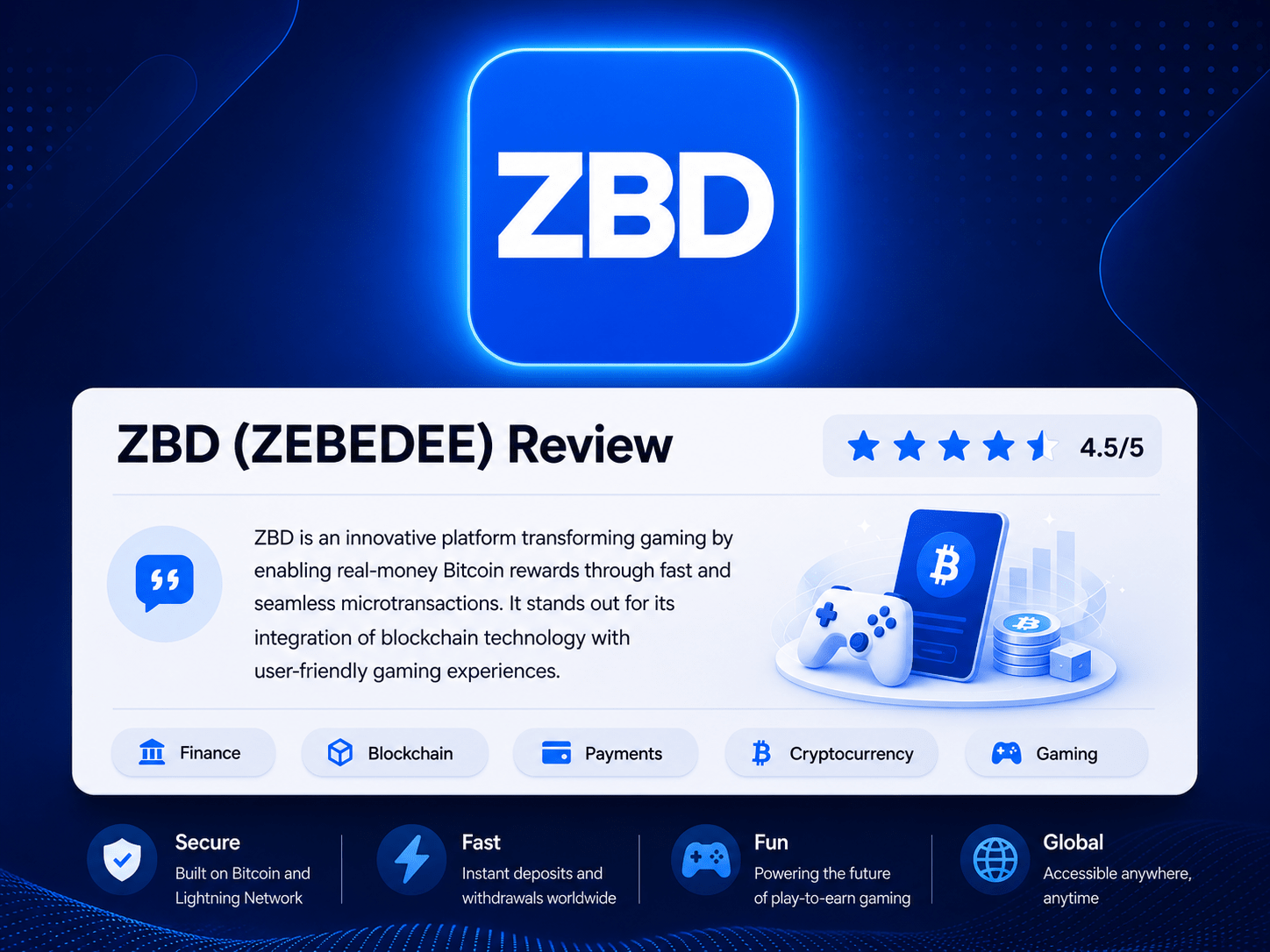
Gaming has always been about more than entertainment. From the first arcade tokens to in-game currencies worth millions, players have always assigned real value to virtual worlds. But for the longest time, that value could never travel back out into the real world. ZBD (ZEBEDEE) is quietly changing that — and the method it’s using is as elegant as it is bold: Bitcoin.
Also Visit Dailyupdates360
01 — THE COMPANY
What is ZBD (ZEBEDEE)?
Founded in 2019, ZEBEDEE started as a Bitcoin wallet with a very specific idea in mind: what if you could earn real money just by playing games? Not gift cards, not redeemable points with questionable value — actual Bitcoin, spendable anywhere in the world.
At its core, ZBD is a fintech and gaming platform built on the Bitcoin Lightning Network. It provides game developers with developer-friendly APIs and SDKs to embed real Bitcoin payments directly into their products, and gives players a smooth mobile wallet to receive, hold, and spend those earnings.
$46M+
Raised in funding
2019
Founded
2M+
Bitcoin Miner downloads
Think of ZBD as the payment engine powering a new kind of game economy — one where in-game achievements translate to real satoshis (tiny fractions of Bitcoin) that players can actually withdraw, send, or spend.
02 — THE PROBLEM
Why Traditional Gaming Rewards Are Broken
Anyone who’s spent hours grinding a mobile game for coins, gems, or experience points knows the frustration: all that effort, and your rewards are locked inside a walled garden. You can’t cash them out. You can’t transfer them. And if the game shuts down tomorrow, they’re gone.
“In most games today, value only flows one way — into the game. ZBD flips that equation, letting value flow out to the player as well.”
Beyond the reward problem, there’s a deeper issue with digital payments in gaming: friction. Moving money across borders involves banks, currency conversions, fees, and delays. For a teenage gamer in Brazil or the Philippines who just won a match, the last thing they want is a three-day settlement window and a 5% cut going to intermediaries.
ZBD was built precisely to address this gap — bridging the space between digital entertainment and real-world financial value, without the traditional mess.
03 — UNDER THE HOOD
How ZBD Actually Works
Here’s where it gets interesting, but stay with the analogy: imagine the Bitcoin blockchain as a highway. It’s secure, global, and trustworthy — but during rush hour (high demand), it gets slow and expensive to use for small trips. The Lightning Network is like a series of express lanes built on top of that highway. Transactions happen instantly and for a fraction of a cent, and they only settle back on the main road when you’re done.
ZBD operates entirely on this Lightning Network layer. When a player completes a level and earns 50 satoshis, that payment is processed in milliseconds — no waiting, no inflated fees. The developer doesn’t need to build payment infrastructure from scratch; ZBD’s APIs handle everything, from triggering the reward event to depositing it in the player’s wallet.
A user in Brazil can earn bitcoin playing a casual mobile game, then instantly transfer that money and exchange it for Brazilian reais — all without ever touching a bank.
Players receive a customizable Lightning Address — something like yourname@zbd.gg — that works like an email address for receiving payments. Simple, human-readable, and borderless.
04 — WHAT SETS IT APART
Key Features and Benefits
⚡
Instant payouts
Lightning Network enables near-zero latency payments — rewards hit wallets within seconds of being earned.
💸
Micro-level fees
Typical fees are measured in single-digit satoshis — fractions of a penny, making microtransactions genuinely viable.
🔧
Developer APIs & SDKs
Game studios can integrate real-money rewards into new or existing games without rebuilding their payment stack.
🌍
Real-world earning
Players convert in-game achievements into Bitcoin withdrawable in local currency via global payment partners.
ZBD also holds real regulatory credentials — US Money Transmitter Licenses, EU EMI and MiCA licenses, and a certified Visa Direct partnership. This isn’t a crypto startup playing fast and loose; it’s a compliant financial infrastructure for the next generation of games.
05 — REAL-WORLD IMPACT
Use Cases in Gaming and Beyond
Play-to-earn without tokens: Unlike NFT-based P2E games that rely on volatile project tokens, ZBD uses Bitcoin — the most established digital asset — as its sole reward mechanism. Bitcoin Miner, a casual mobile game, has over 2 million downloads and demonstrated a 400% increase in day-7 player retention after integrating ZBD bitcoin rewards.
Esports rewards: ZBD partnered with Stattrak to launch a fantasy esports platform offering real Bitcoin payouts for popular competitive games — turning spectatorship into an earning opportunity.
Global remittances: Players in the Philippines and Brazil can earn satoshis in games, convert them to local currency instantly via ZBD’s partners Pouch and Bipa — effectively using gaming as an on-ramp to borderless financial services.
Content creator economies: With Nostr support added to the ZBD app, creators can monetize content using decentralized identities — opening up programmable tipping and payments outside the traditional gaming context entirely.
06 — THE BIGGER PICTURE
Why ZBD Matters in 2025 and Beyond
We’re entering an era where the line between digital economies and real economies is dissolving. Global gaming revenue already dwarfs Hollywood. Billions of people — many without traditional bank accounts — have smartphones and play mobile games daily. ZBD sits at the intersection of these trends with a proposition that is genuinely new: games as financial on-ramps.
For game developers, ZBD converts what’s traditionally been a cost center (payments infrastructure) into a monetization flywheel. Rewarded gameplay drives higher engagement. Higher engagement means more sessions, more in-app purchases, and stronger retention — the Fumb Games case study with Bitcoin Miner is a live proof point.
For players in emerging markets, the implications are even more profound. A gamer in a country with limited financial access doesn’t need a bank account to earn and transact through ZBD. The game is their portal.
07 — A FAIR LOOK
Challenges and Honest Considerations
Crypto volatility
Bitcoin’s value fluctuates — a reward worth $2 today might be worth $1.80 tomorrow. For small earners, this volatility can feel unpredictable. ZBD’s partners offer local currency conversion, which helps, but the underlying exposure remains.
Custodial security trade-offs
ZBD operates a custodial wallet, meaning users don’t directly control their private keys. For small amounts earned gaming, this is fine — but it’s not suited for long-term Bitcoin storage or significant holdings.
Adoption and awareness
For most mainstream gamers, “Bitcoin” still sounds complicated or risky. ZBD has done impressive work abstracting away complexity, but educating casual players on the value of their satoshi earnings remains an ongoing challenge for the ecosystem as a whole.
None of these are insurmountable problems — they’re the natural friction points of any early-stage infrastructure. The key is that ZBD is actively working to smooth them out rather than pretending they don’t exist.
The game has changed — and ZBD is writing the rules
There’s something quietly revolutionary about a gamer in São Paulo earning Bitcoin by playing Solitaire on their lunch break, then using those funds to send money to a relative in Manila — all without a bank, a wire transfer, or a three-day wait. ZBD makes that real today.
Whether you’re a developer looking to level up your game economy, a player curious about earning real value from the time you already spend gaming, or just someone watching where the future of digital money is headed — ZBD deserves your attention. The intersection of gaming, Bitcoin, and financial inclusion is not a distant possibility. It’s already here.
Also Visit Dailyupdates360